Insurance MGA Bordereaux Processing Automation
AI extraction absorbs messy MGA file formats so carriers can trust the data.

Bordereaux processing automation addresses a structural weakness in delegated authority insurance. The work breaks down at scale because every relationship brings another document format to interpret. Effective automation absorbs that variation at intake, then validates, reconciles, and reports the data without passing the same cleanup burden down the line.
What bordereaux are and why they exist in delegated authority insurance
A bordereau is the periodic report an MGA or coverholder sends to the carrier whose authority it exercises. It records business written, premiums collected, or claims handled. The division of responsibility makes this reporting essential. The MGA makes underwriting and claims decisions, while the carrier bears the financial risk. Bordereaux bridge that information gap.
Different reports serve different purposes. Premium bordereaux record policies, gross written premium, commissions, and net premium due, while claims bordereaux record losses, payments, reserves, and claim status. Combined reports bring premium and claims together, and reinsurance technical accounts turn the relevant figures into a settlement balance. These are governance instruments. A late, incomplete, or malformed bordereau can leave reserves stale and regulatory submissions delayed, weakening the mechanism that makes delegated authority viable.
Why bordereaux processing breaks down as the number of delegated authority relationships grows
Carrier requirements often specify what to report without prescribing how to arrange it. Consequently, operations teams receive PDFs, multi-tab Excel workbooks, CSVs, scanned reports, and password-protected spreadsheets containing similar information in dissimilar forms. Headers vary, currencies follow different conventions, and dates switch between DD/MM/YYYY and MM/DD/YYYY. Formats also change mid-program, without warning. A spreadsheet is not contractually obliged to remain recognisable.
There is no broadly adopted standard to absorb this variation. RETACC, the UN/EDIFACT message type for reinsurance technical accounts, never achieved broad adoption, leaving normalization largely with operations teams. Manual handling can remain manageable across ten or twenty delegated authority relationships, but at fifty or one hundred, reformatting can consume more time than analysis. Each rekeying step introduces another opportunity for a transposed reserve figure, wrong class-of-business code, or currency mismatch. Errors may then remain buried until reconciliation or annual audit, when tracing them becomes a separate project.
Skilled analysts spend their time making files usable instead of reviewing premium adequacy, exposures, and loss trends. Adding relationships adds cleanup work, so costs rise with volume. More diligence cannot make incompatible layouts become compatible.
Why AI extraction handles format inconsistency where template-based tools and RPA fail
Template-based tools need a known layout to extract the data. One MGA might put “Gross Written Premium” in column F of a 12-column spreadsheet, while another puts “GWP” in column D of a 27-tab workbook. Supporting both requires separate configurations, and maintaining those configurations becomes another operational workload. Robotic process automation, or RPA, faces a related limitation. It automates keystrokes, but still depends on predictable inputs, so format drift can break the bot and return the work to a person.
AI extraction instead looks at headers, the data types beside them, and how fields relate to each other to find information wherever it sits. New counterparties still require extraction logic, but not another custom ETL pipeline for every layout. Bordereau.ai implements this through a schema-mapping layer with AI suggestions, reusable templates, conditional rules, and inline transforms. The carrier defines the required output structure, while the mapping layer handles differences in incoming documents.
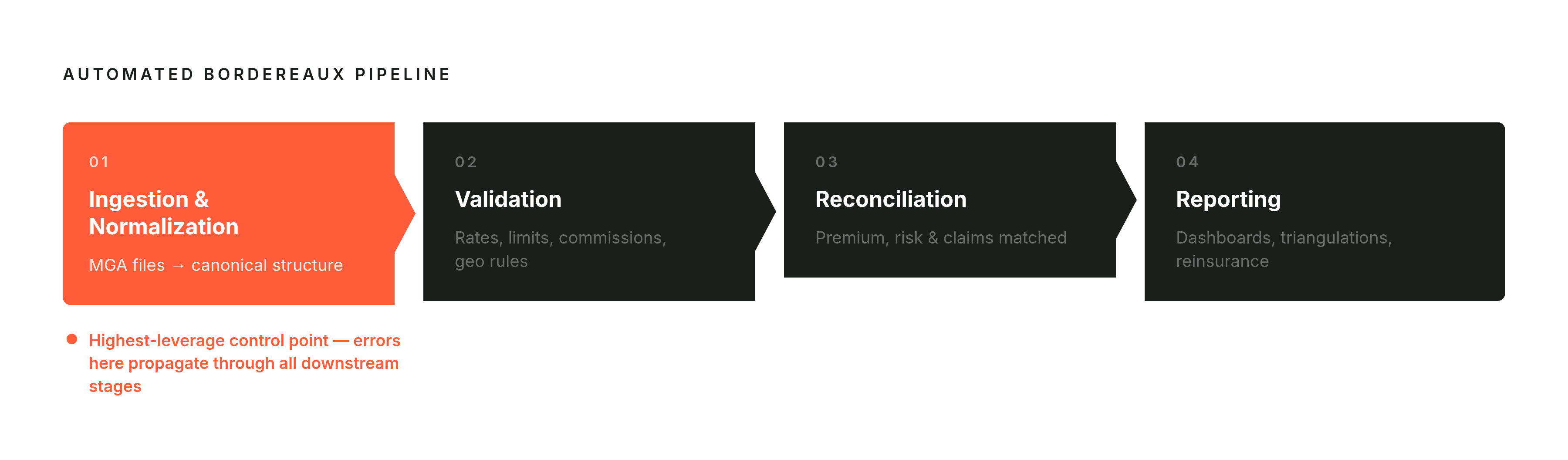
Stage one: ingestion and normalization — turning heterogeneous MGA files into a canonical data structure
Consider a Monday-morning file in an unfamiliar format. Before anyone can judge the business it describes, its contents must be translated into fields the rest of the workflow understands. That is the job of ingestion and normalization. The automation layer can pull policy, premium, and claims data from management systems such as Applied Epic or AMS360 at the reporting period’s close, then apply carrier-specific mappings. Incoming documents need the same conversion into a consistent structure.
Extraction targets depend on the report. Premium data needs a Unique Market Reference or policy number, insured details, policy dates, gross written premium, commissions, and net premium due. Claims data needs claim references, loss dates, paid amounts, outstanding reserves, and status codes. Free text remains part of the job. Insured names and risk descriptions resist tidy parsing, yet are essential for exposure analysis and audit trails.
Bordereau.ai provides AI-assisted correction for fuzzy address matching, currency normalization, and entity resolution, with explainable suggestions and confidence scores. Those details make uncertainty visible. The resulting records feed validation and reconciliation. An error introduced here can propagate through both, making normalization the workflow’s highest-leverage control point.
Stage two: validation — checking every record against binding authority terms before errors compound
A correctly formatted record can still describe an unauthorized risk. Format validation asks whether the data is structurally usable, while binding authority validation asks whether the business falls within the carrier’s agreed terms. Those are different tests. Rates, commission levels, coverage types, limits, premium ranges, and geographic restrictions must be checked against the applicable authority. Breaches can create carrier audit exposure and potential errors-and-omissions liability.
Continuous validation runs those checks as the data is processed, ahead of the annual review. Bordereau.ai has no-code rules, severity classifications, and exception queues with service-level tracking and automated escalation, so operations teams can set up checks without help from engineers. Timing changes the value of detection. A discrepancy found before reporting is a different operational problem from one reconstructed months later across manually processed files.
Pro Global’s historical data links weak monitoring of delegated business between 2013 and 2019 to deteriorating loss ratios through poor risk selection and inadequate pricing. Validation gives carriers an earlier opportunity to identify departures from agreed terms before the resulting problems accumulate.
Stage three: reconciliation — matching premium, risk, and claims data across parties and programs
Reconciliation matches premium, risk, and claims bordereaux against each other and against policy records, connecting what was bound with what was collected and reported. Bordereau.ai extends this work to credit control, settlement tracking, attestation, and funds-withheld monitoring, with an audit trail. A clean field in one file proves little about its counterpart elsewhere.
Commission reconciliation deserves separate attention because it combines base rates, contingent commissions, volume bonuses, producer splits, and chargebacks for early cancellations or lapses. Discrepancies can become producer complaints, making this an especially visible bottleneck for MGA finance teams. Multi-carrier accounts payable adds more work because vendor invoices must be assigned to each program, have the right general-ledger coding, and be approved under that program’s authority.
In its work with a reinsurer, FurtherAI found that roughly half of every 200-hour audit was spent on manual extraction and validation before experts began to use their judgment. The preparation itself consumed substantial professional time. Automating that work leaves more room for the underwriting and actuarial decisions that a reconciled dataset is supposed to support.
Stage four: reporting and what automated bordereaux output actually enables
Timely, structured exposure data supports underwriting, reserve estimation, compliance, and reinsurance settlement. That is a larger gain than a neater spreadsheet. Manual processing can introduce days or weeks between a coverholder binding a risk and the carrier receiving usable information, leaving decisions dependent on stale exposures. Reporting automation becomes useful when it shortens that gap without sacrificing traceability.
Bordereau.ai provides operational dashboards, loss triangulations, year-of-account reporting, coverholder benchmarking, and a self-service report builder. These outputs depend on the preceding controls. The reinsurance technical account, for example, aggregates premium and claims information into a formal settlement document, so surviving errors require costly tracing and correction.
Insly argues that MGAs that start with underwriting AI before they have clean intake build on shaky data and miss out on returns that grow on one another. Reserving tools and regulatory reporting share that dependency. Normalized, validated, reconciled records provide the foundation on which those downstream capabilities can work reliably.
What automation changes for MGAs operating across many carrier relationships
Unitary’s 2025 Lloyd’s-market deployment provides a concrete example of the operational shift. Its AI-powered virtual agents handled 99% of bordereaux submissions without help from people. That result describes a particular deployment. It nevertheless shows that format variation need not force every submission back through manual processing.
Under manual workflows, each new relationship brings another stream of files to read and reformat, which often takes more capacity from the operations team. With AI extraction, onboarding centres on updating the counterparty’s extraction logic. The same team can consequently support more programs. The gain is that their differences no longer require the same repeated effort.
This also changes where staff attention goes. The system can handle routine processing while people focus on exceptions, exposure analysis, and work that needs their judgment. Faster cycles can cut the reconciliation delays that lead to carrier disputes and producer complaints. But those gains depend on keeping control over the work being automated.
The governance and regulatory dimension that shapes how automation must be deployed
Automation without documented controls exchanges manual error risk for regulatory exposure. Carriers must be able to demonstrate that the data driving reserves and regulatory submissions is accurate and traceable. Every AI-assisted correction therefore needs an explanation and a logged record. A confidence score is useful evidence. Continuous exception-based oversight helps carriers defend their work by flagging discrepancies before they build up.
The Lloyd’s market also has Atlas submission standards, and errors can lead to delegated authority reviews. Access and data location also require deliberate decisions. Bordereau.ai offers role-based access, SSO integration, and data residency options in the UK, EU, Switzerland, Canada, and UAE. Its binder registry records contract sections, limits, insurer splits, commissions, and version history, providing the reference against which authority can be assessed.
These controls belong in deployment from the start. A 30-day diagnostic and configuration period is not simply administrative overhead when it establishes the rules, permissions, and evidence needed to defend the system’s output. Speed is useful only if the resulting process remains accountable.
How embedded deployment gets a bordereaux automation system live without a six-month IT project
Embedded engineering brings implementation into the MGA’s existing tools and working practices. Instead of handing operations a configuration document, an engineer works directly with the team to get the first workflow live. The team supplies knowledge that software alone cannot supply. Its understanding of counterparty formats and carrier requirements informs extraction logic and validation rules from the outset.
Unitary deployed its agents in weeks rather than months without replacing existing systems. The agents worked inside the tools the operations team already used, avoiding a prerequisite systems replacement. That experience illustrates a practical alternative to a lengthy enterprise implementation. It does not establish that every deployment will follow the same timetable.
SANSA offers an embedded-engineer model with a 30-day deployment approach for SMB-sized teams. Its relevance here is the delivery model, rather than a claim that one product fits every MGA. Close involvement with the people who own the work can make configuration more accurate while reducing the burden placed on a small operations team.
What to look for when evaluating bordereaux management software in 2026
Test a platform against the three most difficult counterparty formats currently processed manually. Then examine validation depth. The system should check rates, commissions, limits, and geographic restrictions against binding authority terms.
Explainability needs an equally practical test. AI-assisted corrections should have confidence scores, explanations, and logs suitable for regulatory review, while exceptions should reach the right person with context, severity, and service-level tracking. Data residency and role-based access are requirements where jurisdictional obligations apply. Structured output should also feed into the management systems already in use and the downstream underwriting, reserving, and reporting tools without adding another export task.
Pricing and implementation determine how widely those capabilities can be used. Per-user fees can put teams off giving access to people across finance and underwriting, while volume-based pricing ties the cost to how much work is processed. Finally, examine who will configure the first counterparty format. An embedded option belongs in that assessment alongside other vendors. Who turns the MGA’s difficult real-world files into a working process, and how much of that job falls back on the operations team?