Freight Broker Carrier Onboarding Automation
Automating carrier intake lifts a hidden cap on coverage, safety, and growth.
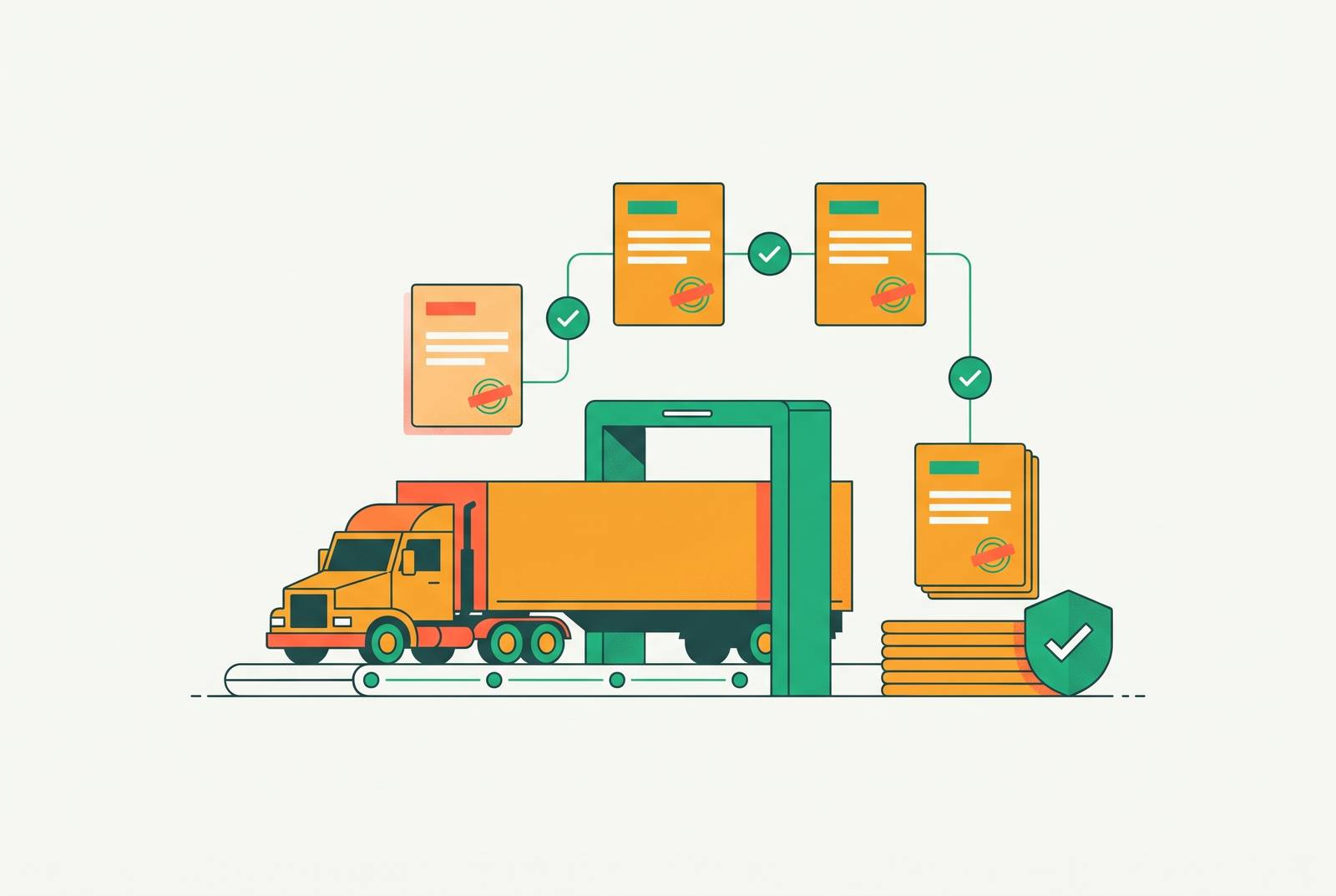
Carrier onboarding automation removes more than paperwork from freight brokerage. It removes a constraint on which loads a team can cover, how safely it can select carriers, and how far it can grow. It works by bringing document collection, systematic verification, and continuous monitoring together. Speeding up intake alone still leaves the gaps that cost the most.
Why carrier onboarding is the bottleneck that shapes every other brokerage operation
A manual carrier packet takes 35 to 45 minutes of a rep’s concentrated attention. That means working through faxed forms, emailed PDFs, and calls to carriers and insurance producers before a load can move. Qualification, authority verification, insurance confirmation, safety review, fraud screening, contract execution, and transportation management system setup all have to clear. Nothing about this is optional administrative tidying. The brokerage must complete onboarding before it can legally tender freight to that carrier.
The time cost grows with the carrier network. A brokerage adding dozens of carriers a week commits a substantial share of its operating capacity to intake before those relationships produce any coverage. Entering data by hand also causes TMS errors, while documents lost in email chains leave gaps in compliance. Approval then becomes a snapshot of the carrier’s status at intake. A carrier that qualified at intake may have lapsed authority, expired cargo insurance, or a failed CSA threshold when the next load becomes available.
That makes onboarding a constraint on growth. New lanes, freight types, and seasonal demand require carriers the brokerage can activate in time to use. Hiring another person moves the limit without changing its cause, because throughput still depends on human hours. The paperwork queue becomes a capacity queue. A brokerage may have the commercial skill to win freight and still lack the intake capacity to cover it.
How freight fraud enters through the onboarding gap — and what it costs
An impersonator can copy an established carrier’s MC number, DOT number, and insurance details. A rushed reviewer may confirm that each document exists without checking whether the fields agree or belong to the party presenting them. The packet looks complete, which is not the same as legitimate.
Double brokering exploits the gap after approval. A carrier that passed an initial check can re-tender freight without authority while the original broker has no continuous monitoring in place. Manual checks can work adequately at low volume, but workload pressure encourages skipped steps precisely where inconsistencies need scrutiny. A May 2026 court ruling removed the federal preemption defense for state-law negligent-selection claims, so poor vetting now carries added legal risk as well as costs to the operation. Fixing this takes cross-field verification and ongoing monitoring along with a faster path from the inbox to carrier approval.
What automated carrier onboarding actually does, step by step
Automated onboarding follows the packet’s dependencies while running independent checks in parallel. It begins with the carrier’s MC and DOT numbers, which the agent uses to query FMCSA in real time for authority status and CSA scores. The rep no longer opens a browser tab, finds the record, and transcribes the result. The lookup becomes part of the intake itself. Its result contributes to a verification process that must finish before the carrier record opens in the TMS.
Insurance verification addresses a different part of the packet. The agent parses the certificate of insurance, checks coverage type, limits, and expiration date, and compares the named insured with the entity presenting the credentials. At the same time, the structured intake flow gathers the tax form and signed carrier agreement. Missing documents trigger automatic follow-up.
Authority, insurance, banking details, physical address, contact information, and domain history are checked against one another and known-fraud patterns. This is where individually plausible details can expose a collectively implausible identity. Only a complete, verified, consistent packet permits TMS activation. “The rest will arrive later” is no longer an approval method.
Activation does not end the verification process. Monitoring continues against the live carrier record for authority revocations, insurance lapses, CSA score changes, and identity-spoofing patterns, with anomalies flagged before load tender. Behavioral checks also flag things for a person to review. A carrier with two years of flatbed activity in the Southeast suddenly bidding on high-value electronics in California warrants attention. That change is a reason to investigate.
What the automated process replaces in time, errors, and compliance exposure
The immediate subtraction is routine handling time. A 35-to-45-minute manual packet compresses to minutes of agent execution, with people attending to flagged exceptions. Manual FMCSA lookups disappear, as does email chasing for tax forms and signed agreements. Transcription into TMS fields is replaced by direct entry from verified source data. This removes the manual-entry errors identified as the leading source of TMS record problems, rather than asking staff to become more careful typists.
The second subtraction is variation in how approval happens. Each carrier passes through the same required checks and approval gates, even where independent checks run concurrently. Workload, time of day, and the rep assigned to the packet no longer determine which steps receive attention. Completeness becomes a condition of activation.
The third subtraction is re-verification by memory. A carrier approved six months ago is not left untouched until someone remembers to look again. Continuous monitoring takes care of those checks, and the vetting record shows how the carrier was assessed. In the post-May 2026 liability environment, that record has legal as well as operational value. It supports the brokerage’s account of its diligence without making the carrier-selection decision risk-free.
How removing the onboarding bottleneck changes what the brokerage can take on
With manual intake, a carrier may have the capacity needed but be unable to take the load because the packet is unfinished. Automated intake lets the brokerage respond to a capacity crunch by activating new carriers in time. The distinction changes whether the team can accept freight it would otherwise lose.
The same constraint governs expansion into new lanes, freight types, and geographies. Those opportunities require a supporting carrier network, and manual onboarding can delay its development by weeks or months. A five-person team can instead operate a continuous intake pipeline without adding compliance headcount for each increase in volume. That gives a small shop access to a function it could not staff separately. Its commercial reach is no longer set so tightly by the number of people available to process packets.
SemiCab’s published February 2026 results show individual operators on its AI-driven platform managing more than four times the loads of a traditional benchmark. SANSA’s work with a paper freight company returned a documented 160+ hours per month to the team, shifting time from coordination overhead to commercial activity. These are broader workflow results covering onboarding automation alongside other operational activities. They show what teams can do when better intake is linked to check calls, document collection, and settlement matching, taking the work beyond the carrier packet.
What automation does not replace — and why that matters for how to implement it
Brokers still need to use their judgment because a complete packet leaves some business questions unanswered. Whether to use a borderline carrier on a critical lane still requires a human decision within the brokerage’s requirements. So do managing a shipper through a service failure, negotiating with a carrier that has competing options, and pricing freight where lane history is thin. The objection to replacing judgment is legitimate.
Agents handle document chasing, FMCSA queries, consistency checks, TMS entry, re-verification, and exception flagging. Brokers use the resulting information to make decisions and manage relationships. The intended outcome is fewer people occupied with coordination and the same or more people doing commercial work. Loads per employee can rise without treating lower headcount as the objective.
Liability stays with the brokerage’s decisions. Automation documents the diligence supporting the human choice. A record of consistent criteria and continuous monitoring puts the broker in a stronger position than a spot-check and a rep’s recollection. Systematic vetting is therefore a defense-supporting process. The increased exposure is a reason to establish that process sooner.
What a 30-day deployment sequence looks like for a small freight brokerage
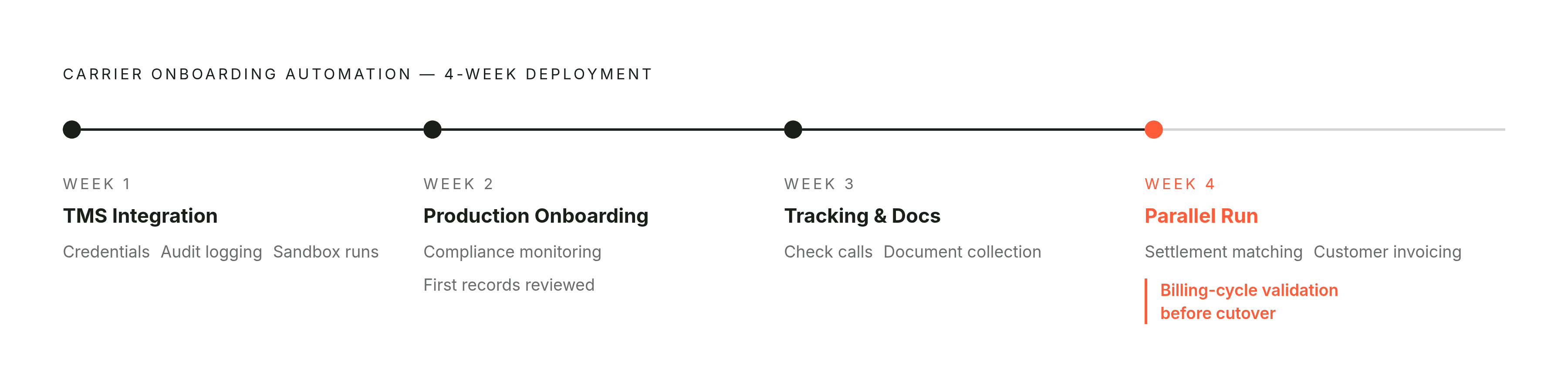
For a small brokerage, the recommended starting point is carrier onboarding and compliance monitoring, integrated into the existing TMS. TFSF Ventures’ 2026 deployment framework structures a four-week rollout around connections to the TMS, ERP, factoring platform, carrier portal, and document workflow. The first week establishes the TMS and carrier-vetting integration, scoped credentials, audit logging, and a sandbox for initial runs. Production loads stay outside those initial tests. The foundation must be verified before the agents touch live work.
Week two brings onboarding and compliance monitoring into production. Manual packet assembly gives way to the structured intake process, and the first automated records provide a baseline for the team to review. Monitoring also starts checking carriers between their first approval and the next time they are used. This is the first operational handover. The team can now judge how the rollout is going by reviewing completed packets and flagged exceptions as well as the plan.
Week three extends the agent stack to check calls, tracking updates, and document collection. These are high-volume, repetitive workflows that otherwise keep brokers occupied with routine status requests. Week four then brings settlement matching and customer invoicing into a parallel run with the existing process for one billing cycle. The back office validates the output before cutover. That distinction keeps a fast deployment from becoming an untested one, and the billing-cycle validation remains a condition of the handover.
SANSA is a named option for this kind of broader workflow automation, with the freight-client result providing a concrete reason to evaluate it. The deployment model is integration around existing systems. Speed has an economic consequence here. A working system that completes routine packets and flags exceptions produces value from day 31, while one still being scoped in month four does not. Each added workflow can build on the first deployment, making onboarding the foundation of the program.
What the brokerage looks like on the other side of automated onboarding
After the change, onboarding becomes part of live freight coverage rather than a preparatory task that must finish well in advance. A broker can go after available capacity knowing intake can finish in time to cover the load. The carrier network is also maintained as a current operating resource, with re-verification governed by the system. That changes the working day. Brokers spend time on rate negotiation, shipper relationships, and carrier development that they once spent chasing documents and entering data into fields.
For a five-person brokerage, this opens freight that once required a larger support operation to manage safely. The brokerage can grow without the same rise in packet handling, and a deeper carrier network gives the commercial team more carriers it can use. Early adopters can compound that advantage as their networks and loads per employee grow. Manual competitors remain tied to the same arithmetic of staff hours and intake queues.
The ceiling on a small brokerage’s reach was never simply talent or ambition. It was access to systems that could turn those qualities into greater operating capacity without weakening verification. Those systems are now a 30-day deployment away.