Win-Loss Analysis for SMBs Without a Sales Team
A five-question framework turns lost deal insights into millions in recovered revenue.

A two-point win rate improvement, applied to a company running $10 million in quarterly pipeline, adds roughly $1 million in new revenue each quarter. Over a year, that's $4 million, and I have never once met an SMB owner who could tell me their actual win rate to the decimal. Nobody ever built the plumbing to measure it. This is the story of how a business with no sales team, no analyst, and no budget for a win-loss platform builds a real practice around one question: why did we win or lose that deal. Turns out the answer is worth a lot more than most owners assume, and it costs almost nothing to go find it.
What most SMBs are actually doing instead of win-loss analysis, and why it doesn't work
Here's the industry default: a CRM field with a loss-reason dropdown, filled in, sometimes, by whoever ran the deal, based on whatever they half-remember three weeks later. I've pulled these reports, and they're a graveyard. Half the rows are blank in exactly the fields that matter (win/loss reason, competitor named, lead source), and the half that aren't blank usually reflect the seller's face-saving theory of events rather than what the buyer actually experienced.
You cannot find a pattern in a dataset that's mostly blank, and that part's obvious. The subtler problem: even a fully populated dropdown is often the wrong artifact entirely, because most losses happen earlier than teams assume, before a real needs assessment even takes place. Which means all that effort polishing proposals and sharpening the close is aimed at a stage of the funnel where the deal is already decided. Buyers will tell you, if you ask them properly, that the losing vendor could've won with one fixable change. That signal exists somewhere in an email thread, a hallway comment, a text the account manager forgot to write down anywhere except their own memory.
The real failure sits underneath the data-quality problem, though. Nobody owns the question, and ownership is a full-time job demanding consistent attention. If nobody's role includes "find out why we lost that deal," the question quietly dies, every time. The root cause is an org chart problem that surfaces as a data-quality complaint.
What win-loss analysis actually requires, and what it doesn't
Four things, all of them manageable without a specialist: a consistent moment to capture information, a short set of structured questions, a place for the answers to live, and a recurring review.
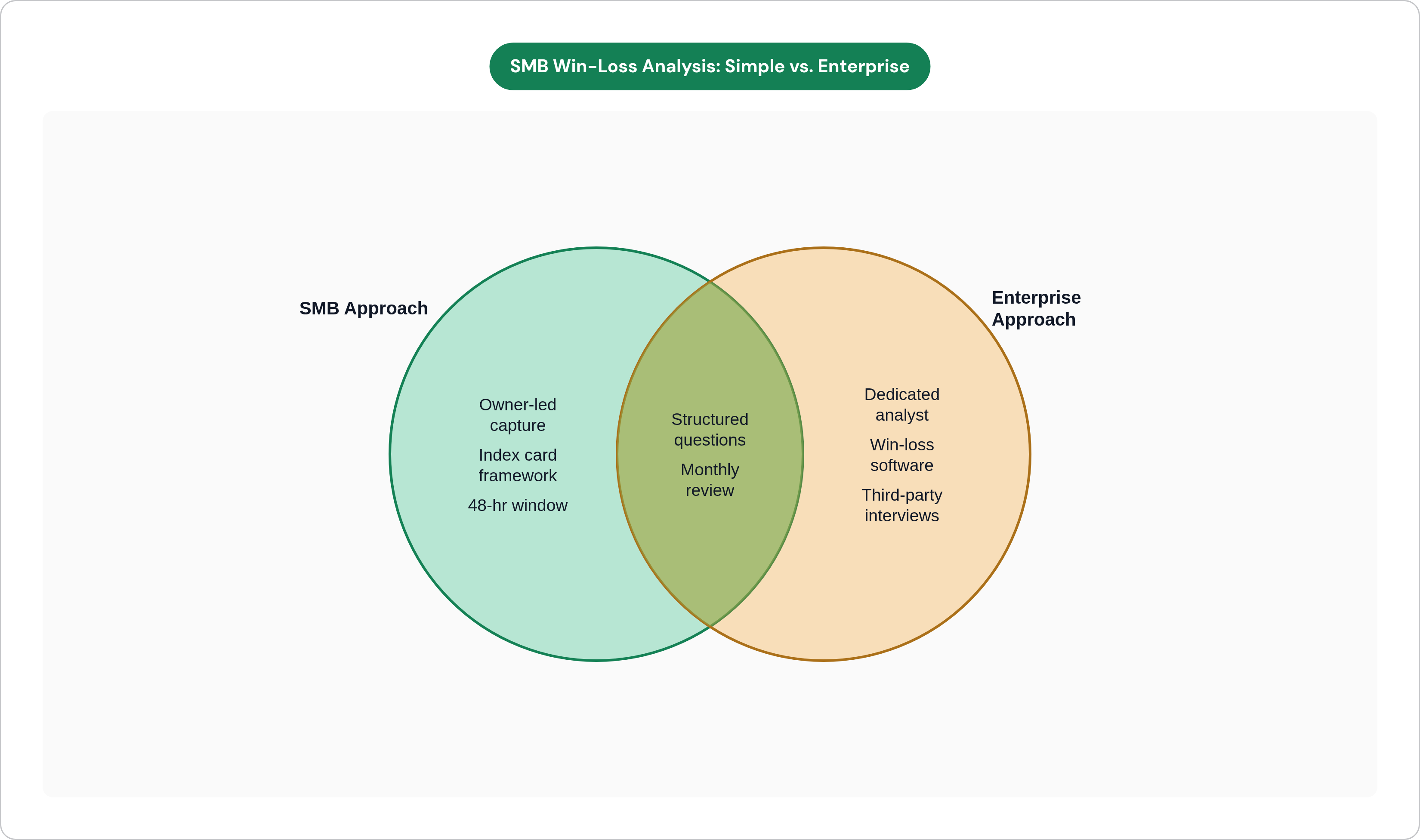
The enterprise version bolts on a dedicated analyst, a win-loss software subscription, third-party buyer interviews, and a consulting retainer, because that version is built for a company running hundreds of deals a month through a formal sales org. Good for them. The SMB version skips all of it: the owner or account manager captures the signal themselves, right at the moment the deal closes or dies, because they're the only one who was in the room anyway.
Five questions, answered within 48 hours of resolution, logged in one shared place. Why did the buyer choose us, or not. What alternatives did they weigh. What almost changed the outcome. What would've made the decision easier. That's the whole framework, and it fits on an index card. Companies that adopt something this simple tend to keep doing it, because the payoff shows up the moment the first real pattern surfaces, and patterns surface faster than anyone expects once you're actually looking for them instead of hoping they'll announce themselves.
Embedding the capture habit into whoever already owns the relationship
Somebody owns the relationship even in a business with no sales team. Maybe it's the owner, or maybe it's a project lead who sent the proposal and followed up three times before the prospect went dark, the way prospects do. That person becomes the analyst by default, whether they asked for the job or not.
The window is short: 48 hours from close, or from the deal going quiet. Wait longer and memory rots; buyers stay candid for a brief stretch before they move on and rationalize the decision into something politer than the truth. The ask should feel like a favor; "Help us get better" beats a form every single time. For deals that ghost instead of formally closing, soften it further: ask whether timing wasn't right, or whether something on your end got in the way. Even the non-responders answer that one occasionally, because it doesn't read like an interrogation.
Won deals deserve the same treatment, and honestly they're easier, because nobody gets defensive about a deal they won. "What tipped it?" is just as valuable as the loss question and takes half the courage to ask.
Attach the capture step to whatever motion already marks a deal closed, whether that's a CRM stage change, a line in a project tracker, or whatever already exists. Attach it to that existing trigger, and it stays frictionless; move it elsewhere and it becomes a chore that gets skipped the first busy Tuesday. If it takes more than a few minutes, it will not survive contact with a real week.
Building the data structure that turns captured answers into patterns
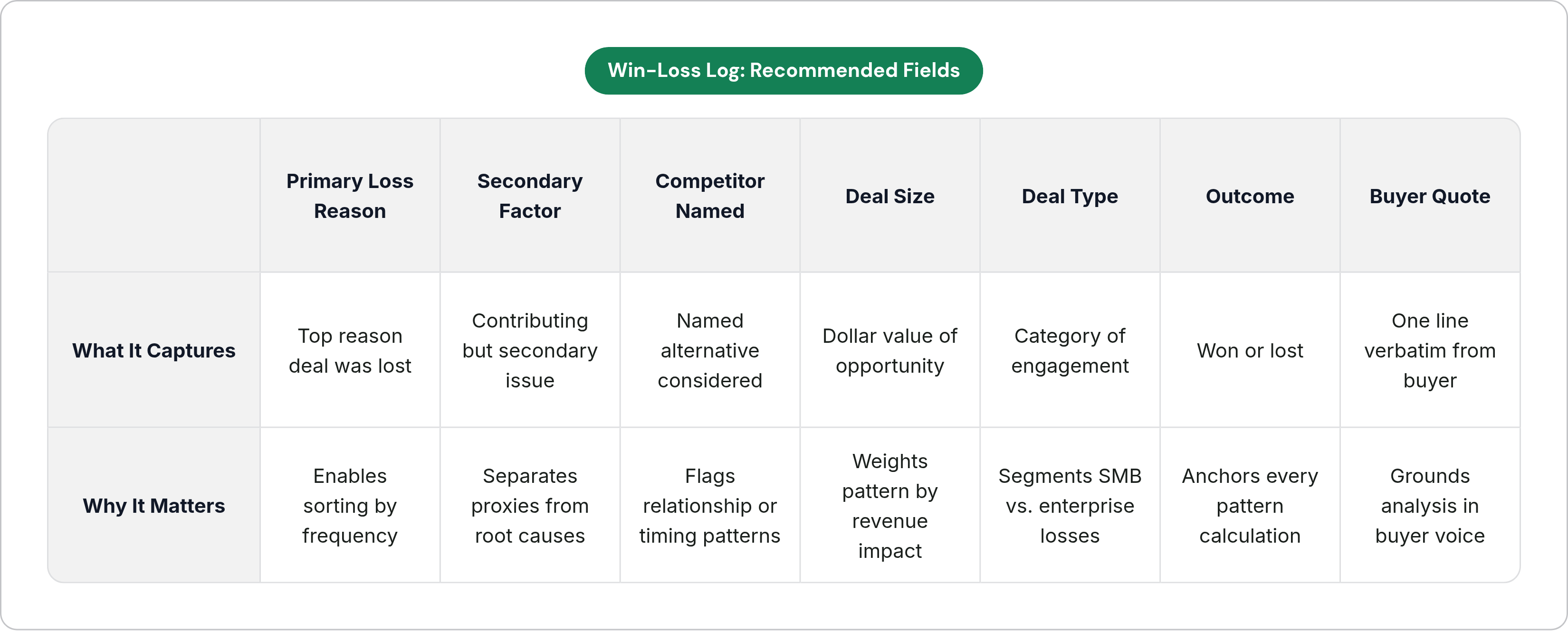
A folder of scattered notes never holds together as a dataset, but a shared log with consistent fields does. Deal size, deal type, outcome, one primary loss reason, one secondary factor, competitor named if any, one line of direct buyer quote. Seven columns, no essay.
Pick the loss-reason categories before you start collecting, while the structure is still easy to set. Five to eight buckets: price, timing, trust, feature gap, competitor relationship, proposal clarity, qualification mismatch. Skip this step and you'll end up with thirty entries that each say something slightly different and mean nothing once you try to sort them.
Patterns become reliable once somewhere around twenty to thirty closed deals sit in the log. Below that, you're reading noise and mistaking it for insight, a more damaging position than having no data to consult. Cross that threshold and sort by loss reason; the top two categories are sitting right there in the sort order, waiting. Tag the wins the same way, by what the buyer says actually tipped them, and that side of the log eventually tells you what to lead with on the next discovery call.
This solves the CRM hygiene problem as a side effect, with the main event being pattern-based insight. A structured log, kept outside the CRM or as a strict habit inside it, puts one person on the hook for filling it in at the moment of close. That single ownership shift closes most of the gap dropdown fields never managed to.
Running the review: a monthly rhythm that fits a small team
For a team under ten people, thirty minutes with the log open on a shared screen gets it done, and a meeting that reaches for slides has already grown too complicated.
Count the wins and losses for the month, name the top loss reason, and walk through one won deal and one lost deal in real detail. Pick exactly one thing to change or test next month, and that last part is the one everyone skips, which is exactly why it matters most. Analysis that produces five changes at once obscures learning, because nobody can tell which change caused which result afterward. Pick the highest-frequency loss reason, and work on that alone for thirty days. Resist the urge to fix everything at once; fixing one thing at a time keeps the signal clear.
Say price shows up in 40% of last month's losses. The next question is whether price is a real constraint, meaning the budget genuinely wasn't there, or a proxy for something else, meaning the buyer never saw enough value to justify the number in the first place. Those are two entirely different diagnoses, and conflating them is how teams end up cutting margin for a problem that was always about perceived value.
Write down what you changed, and the month you changed it, then watch whether that loss reason actually drops over the following months. This is the part that earns the practice credibility inside a team; once someone sees a number move because of a decision made in that thirty-minute session, they stop calling it busywork.
Where AI clears out the grunt work without requiring a new hire or a new system
The manual version holds up fine at ten deals a month, but it gets tedious at forty, and tedious is exactly where practices die.
Summarizing a long email thread into a five-field log entry is a task a model does well: paste in the thread, get a draft summary back, check it, log it. Flagging deals gone quiet past a set threshold without a capture entry can run on plain automation, catching gaps before they pile up into a quarter's worth of missing data. Pattern detection across thirty-plus log entries is another spot where a model earns its keep, feed it the plain-text log, ask for the top two loss themes, and you get a first pass using plain text, skipping BI tools and specialist hires entirely. Drafting the actual follow-up to a lost or ghosted buyer might be the smallest task on this list and also the one most likely to get skipped without help, because typing "can you tell us why we lost" from a blank cursor, every single time, is more friction than it sounds like on paper.
Businesses that skipped this kind of AI-assisted workflow through 2025 ran noticeably slower follow-up cycles, and their win rates lagged the early adopters. The gap traces entirely to execution speed; the underlying method stayed the same. What changed is that a five-person shop can now run a review cadence that used to require a dedicated analyst, because the summarizing, flagging, and drafting now take minutes instead of the hours that used to make the whole thing unsustainable.
What to do when the data reveals something you can't fix with process alone
Some patterns point at positioning. Some point at pricing structure. Some point at the uncomfortable fact that you're chasing the wrong segment entirely, and the log will tell you which, given enough data to complete the picture.
If price tops the list but win rate is otherwise stable, the real problem is probably upstream: the qualification filter is letting in deals that were never going to close on value, and the fix belongs upstream in qualification, not in pricing. If competitor relationship keeps showing up, getting into the deal earlier matters more than sharpening the proposal, especially once the incumbent has three years of goodwill that discounts cannot dislodge. And if losses cluster before needs assessment even happens, which they often do, the fix belongs in qualification. Proposal polish addresses a later stage than where those deals are already decided.
One pattern surprises almost everyone who runs this for six months straight: winning consistently in one sub-segment while losing consistently in another, nearly every time. The right response is narrowing focus toward the segment that consistently converts. Some ponds just don't have the fish you're after, no matter how good the bait is.
Treat loss reasons as hypotheses open to testing. Each one is a test waiting for a design, and the monthly review is where that design gets built.
What a two-point lift actually looks like compounding over twelve months
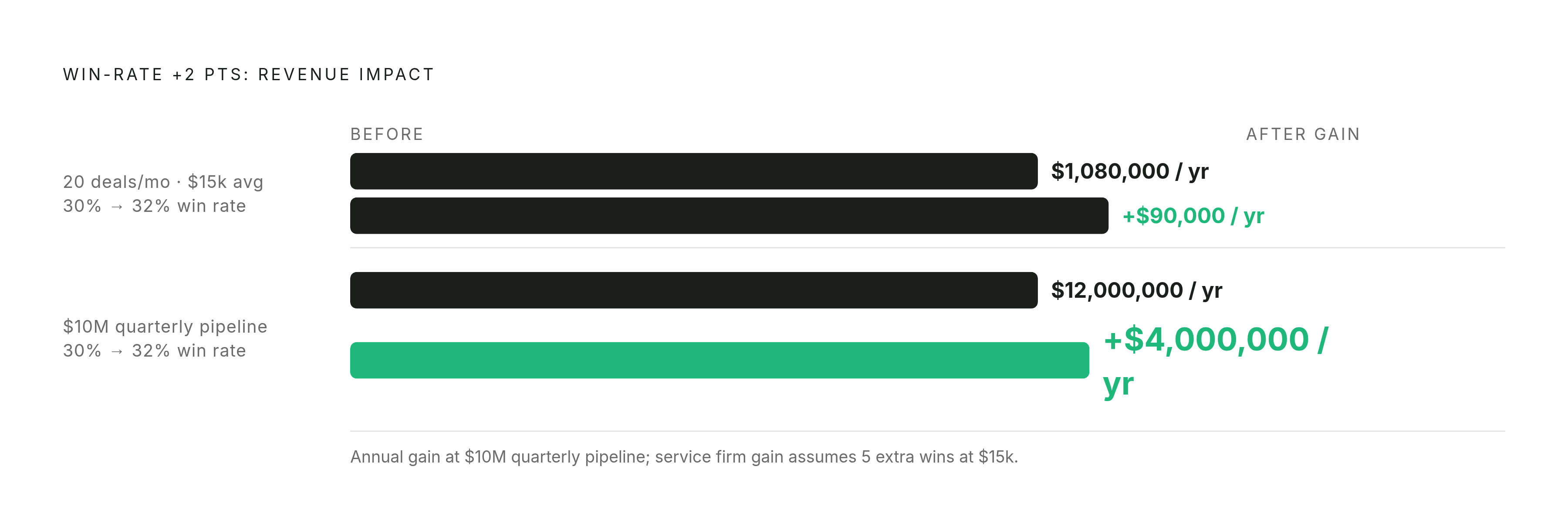
Take a service firm quoting twenty deals a month at $15,000 average deal value. Move win rate from 30% to 32%, hold volume steady, and that's roughly five extra wins over the year. Real invoiced revenue, calculated from actual deal data.
Scale it and the logic holds. At $10 million in quarterly pipeline, two points adds roughly $1 million a quarter, four million a year, and the ratio scales down proportionally for whatever pipeline size you're actually running. Once companies start a structured win-loss review, they overwhelmingly keep it, because it pays for itself fast enough that continuing becomes the obvious choice.
The compounding extends beyond finances. Month six produces sharper reads than month one, because the log has depth and the categories have proven themselves. Month twelve beats month six, because by then you've run four or five of the one-change tests and know which levers actually move the number, separating real drivers from plausible-sounding ones.
For most small businesses, win rate gets treated like weather: something that happens to you, mostly because nobody's ever managed it on purpose. This practice turns it into a variable you control, one you shape rather than endure. So start smaller than you think you need to, and pick one deal that closed or went cold in the last two weeks. Answer the four questions about it today, before you read anything else about platforms or hires or six-month rollout plans.