Using AI to Analyze Customer Feedback at Small Scale
AI uncovers patterns in customer feedback that manual review misses entirely.

The default approach at small scale is familiar: read the occasional review, skim the survey responses when the month-end report demands it, note the complaint a customer called in about last Tuesday. It resembles feedback management but falls short of it. Running a business on that approach is like trying to navigate by looking at your footprints instead of the road ahead — you can see where you've been, but you'll never see what's coming.
What gets lost is patterns. A customer who praises the product but criticizes the checkout experience in the same sentence gets flattened by a manual reader into a net positive or a net negative, not into two distinct data points. A surge of negative shipping comments in the two weeks after a holiday campaign overwhelms whoever is "responsible for reviews" and gets mentally filed under "busy period, probably fine." The signal that would have prompted a logistics conversation never surfaces. Per Talkdesk's August 2025 survey of 400 U.S. small business owners, 51 percent have integrated AI into customer service operations, and nearly one in three are doubling down on customer experience to build loyalty against economic headwinds. Integrating AI into customer service handles volume through chatbots and ticket routing, while systematically analyzing what customers are actually saying extracts meaning; these are categorically different activities. Treating feedback as a data asset gives businesses something concrete to act on.
What AI feedback analysis actually does — and what it doesn't
The inputs are nothing exotic: reviews, support tickets, survey responses, email replies, social comments. The scattered text a small business already generates but rarely aggregates. Natural language processing is where the leverage appears.
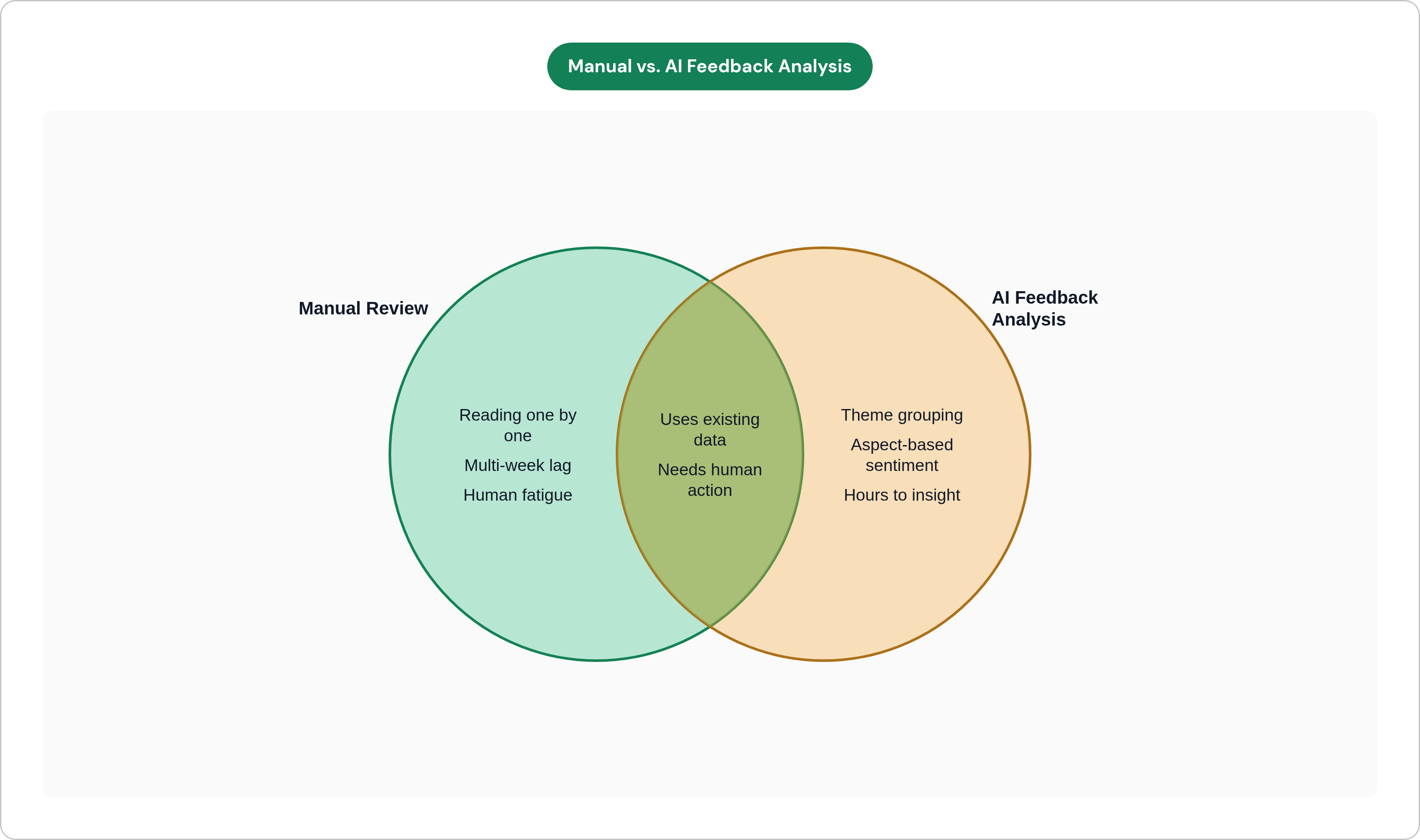
Sentiment classification is the baseline: positive, negative, neutral. Useful, but limited. Theme grouping is more consequential; it clusters comments by topic even when customers phrase things differently, so "slow shipping," "took forever to arrive," and "delivery was a disaster" resolve into a single, countable complaint rather than three isolated grievances. Aspect-based analysis goes further still, separating sentiment by topic within a single piece of feedback, which is what allows a system to recognize that the same review can be enthusiastically positive about a product and sharply critical of the checkout experience at the same time. Automated systems preserve that nuance; manual readers flatten it into a rating, and the difference in downstream decision quality is not trivial.
Modern tools reach accuracy in the high 90s for theme detection and sentiment classification across both vendor and independent benchmarks, placing them in roughly the same range as trained human analysts on structured tasks. Where they outperform humans is consistency at scale: no fatigue, no mood, no skimming after the fortieth ticket. Where they require oversight is predictable: sarcasm, highly domain-specific jargon, and mixed-language feedback all produce outputs worth reviewing before anyone acts on them.
This system surfaces what to decide about; the conversations and the decisions themselves remain with the people running the business. For a lean team, the meaningful shift is themes and sentiment available on demand, replacing the habit of reading reviews whenever time allows.
The decision-making speed gap that makes this worth fixing now
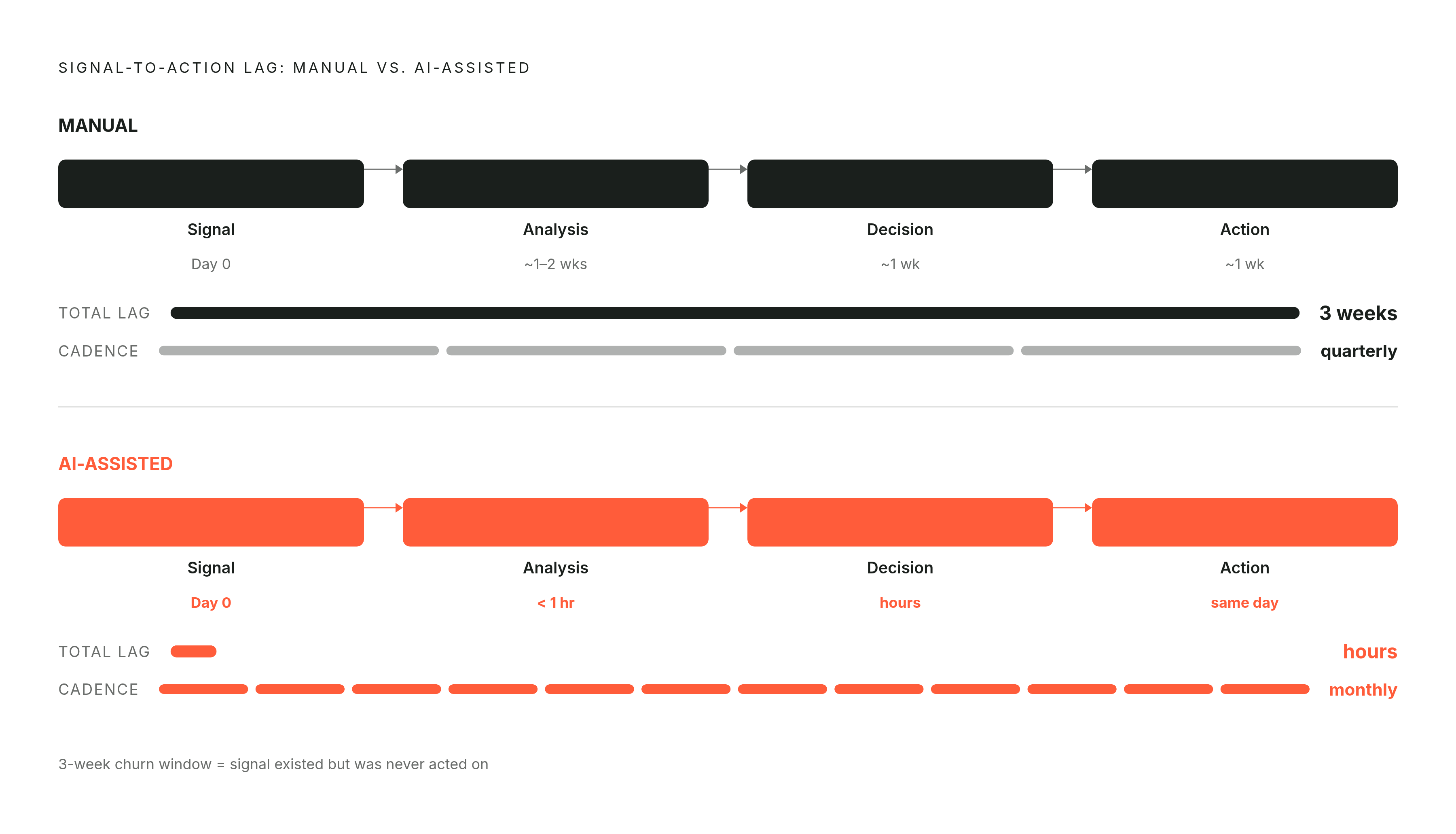
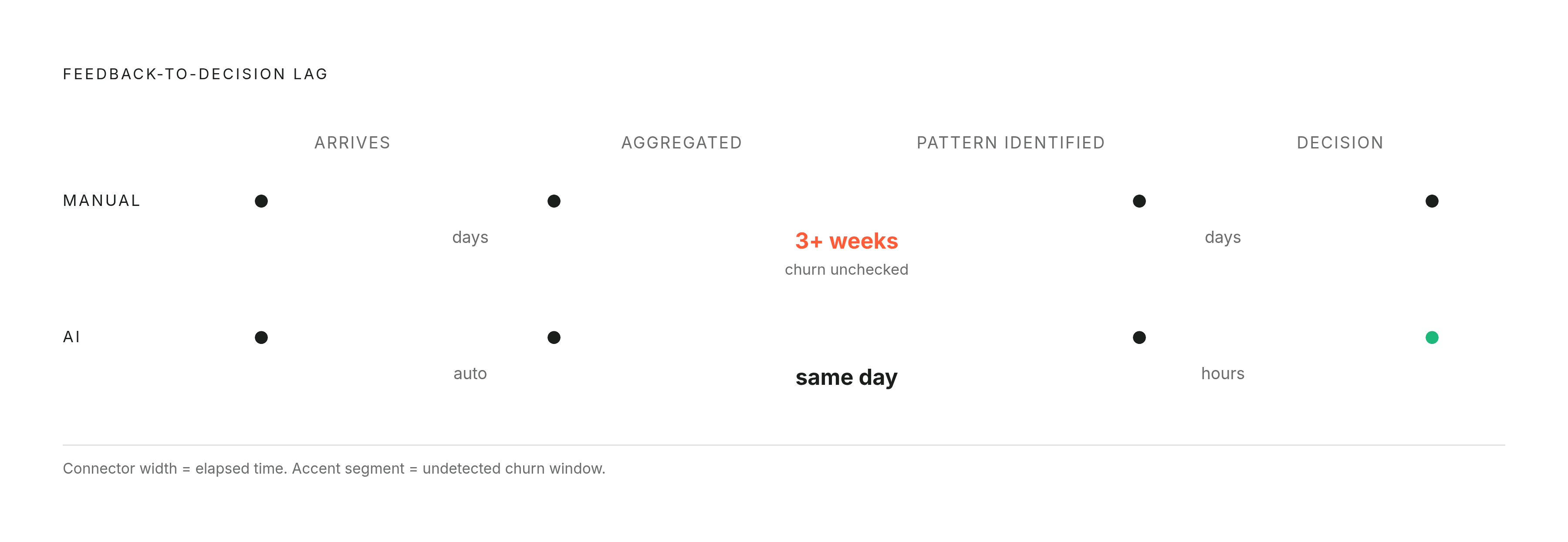
Manual feedback analysis creates multi-week lags between customer signal and business response. A three-week delay in recognizing a recurring complaint is a three-week window in which that complaint keeps driving churn, unchecked. The information existed the whole time, unread and unsynthesized.
AI tools shrink that gap from weeks to hours. The compounding effect of that compression runs deeper than it first appears. Faster insight produces faster adjustment, which produces faster reduction in the problem driving the adjustment. A team running this cycle monthly operates on a fundamentally different improvement cadence than one doing it quarterly. Over a year, the structural distance between those two businesses becomes difficult to close by other means.
Adoption momentum among small businesses reflects growing recognition of this dynamic. Per Thryv's 2025 data, AI usage among small businesses rose from 39 percent in 2024 to 55 percent in 2025, an increase of roughly 41 percent in a single year. Every small business owner I know who made the switch early is now building feedback-to-decision infrastructure while their competitors are still reading reviews manually, one at a time, when a spare hour materializes.
What a working feedback analysis system looks like for a lean team
Start with what already exists. The business almost certainly has feedback data it isn't analyzing systematically: Google reviews, a helpdesk full of support tickets, post-purchase survey responses sitting in a form tool, email replies to a follow-up sequence. The raw material is there, accumulating, largely ignored.
A realistic first build for a 10 to 50-person business aggregates feedback from two or three existing channels into one place, runs theme extraction and sentiment analysis on a rolling basis, and produces a short structured summary: top recurring themes, sentiment shift week over week, any sudden increase in a specific complaint category. Critically, that output gets routed to whoever owns the relevant decision, not buried in a dashboard nobody opens because nobody was explicitly assigned to open it.
The data quality prerequisite deserves directness: the system is only as useful as the feedback going into it. AI amplifies existing signal from real volume. If review volume is sparse or survey response rates are low, the first investment is in expanding collection, not in building analysis infrastructure on top of insufficient inputs.
Thryv's 2025 data indicates that small businesses using AI tools report saving an average of 20 hours per month, a figure that holds for more than half of current users. For a lean team where the owner or a single manager is currently absorbing feedback review personally, that reclaimed time is the first tangible return. The system's job is to surface the one or two things that need action this week, filtering everything else as noise.
How to scope the first implementation so it actually ships
Every failed implementation I've seen followed the same pattern: scoping a system that covers every feedback channel simultaneously, requires custom integrations across five platforms, and has no designated owner. It gets planned carefully and abandoned before launch.
The right starting constraint is almost aggressively narrow: one feedback channel, one output, one decision-maker who will actually use it. Support ticket themes surfaced weekly to the operations lead. Google review sentiment tracked monthly, flagged when a theme spikes above a threshold. Either of those is a complete first system. Both is ambitious. Everything else is scope creep.
Readiness signals are straightforward. The business receives enough feedback volume to surface patterns, a rough floor being enough contacts per week that manual review takes more than an hour. There is at least one consistent feedback channel already capturing text. There is one person willing to own the configuration and review the output: one person, accountable and named.
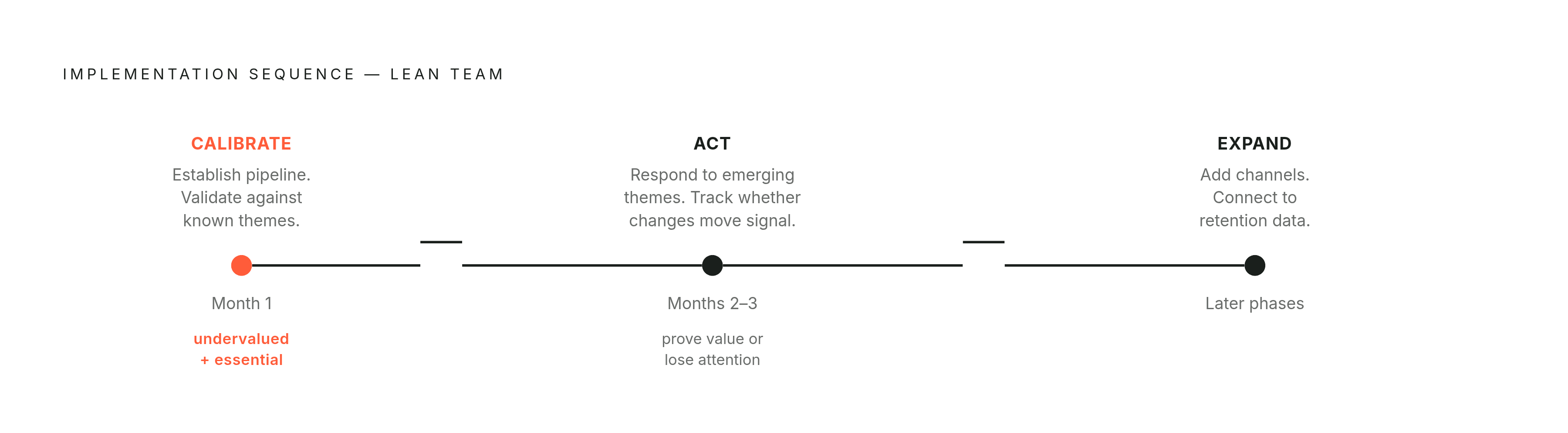
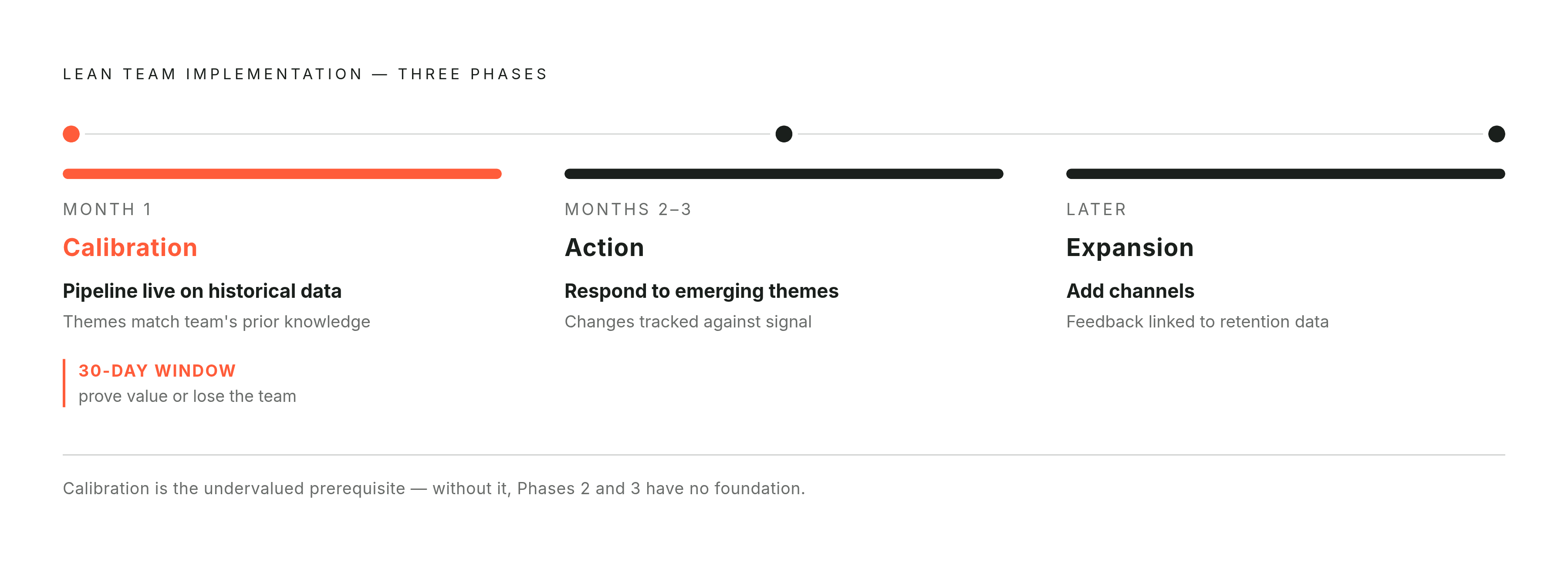
The phased build matters because it prevents the system from bloating before it proves itself. The first month is calibration: establish the pipeline, run it on historical data, confirm that the themes the system surfaces match what the team already intuitively knows. This step is undervalued and essential, because trust must be earned through demonstrated accuracy before the team will rely on the system. The second and third months introduce action: begin responding to emerging themes, track whether changes move the signal. Channel expansion and connections to retention data come later, once the foundation is demonstrably working.
The 30-day target isn't arbitrary. It is the window in which a first system either proves its value visibly or loses the team's attention permanently.
What this means for a team that can't hire a dedicated analyst
A dedicated customer insight analyst is, for most small businesses, an economically unjustifiable role. The work is intermittent, and the salary cost is disproportionate to what the insights would return at that scale. So the owner absorbs it personally, at irregular intervals, with diminishing thoroughness over time, the path most businesses quietly take.
A working feedback analysis system replaces the irregular manual review cycle owned by whoever had a spare hour, the quarterly meeting that produced observations without tracked follow-through, and the guesswork in service decisions made without knowing what customers were consistently communicating. These are common losses. Every small business owner I've worked with accepted them as inevitable because the alternative seemed to require unjustifiable headcount.
Talkdesk's 2025 data shows 94 percent of small businesses expect to grow or maintain customer service staffing, a signal that the customer relationship is recognized as load-bearing. Adding headcount to manage feedback is one path to that capability, and AI-assisted systems offer another. A feedback analysis system extends what the existing team can see and act on, drawing on existing roles rather than a dedicated hire, and firms like Sansatech, a consultancy that builds and deploys these systems for small businesses, typically have a first implementation running within 30 days. For businesses working with an embedded AI partner rather than building entirely in-house, SANSA operates on this model: diagnose the bottleneck, build the system around it, remain embedded as it compounds. The build timeline compresses when someone who has configured these workflows before owns the initial setup, and ongoing iteration, expanding channels, refining theme categories, connecting feedback patterns to business outcomes, accumulates without requiring a new project each time something needs adjusting.
What becomes possible once feedback is a system rather than a chore
The operational return arrives first: faster identification of recurring complaints, cleaner prioritization of what to fix, less time operating blind between when a problem surfaces and when it gets addressed.
The more consequential return is strategic. Feedback themes become direct input to service design; a recurring pattern of customers requesting something the business doesn't currently offer is a product signal, not noise. Sentiment trends over time become a leading indicator, making improvement or deterioration in a specific area visible ahead of retention numbers. A business that can trace its own improvement curve — a theme that peaked in March, a change made in April, a measurable decline by June — has something more durable than a dashboard. It has a record of what its customers actually needed and whether the business responded. That record survives staff turnover, stored in the system rather than in anyone's head.
For a five-person service firm that previously had no feedback infrastructure, the consequences accumulate quickly. Decisions about which services to expand stop being intuition and start being informed by what customers keep requesting. Staff can respond to complaints with genuine context, because the complaint is a known issue being actively addressed.
The ceiling that kept this kind of analysis out of reach for small businesses was processing capacity, not the absence of feedback. Customers have always had opinions, delivered at length and with feeling, and a working AI feedback system removes that ceiling. The same lean team that used to skim reviews now operates with customer intelligence that previously required a dedicated function, a fundamental shift in capability.