Turning Client Onboarding Data Into Product Insights
Connecting onboarding behavior to product decisions before patterns go stale.

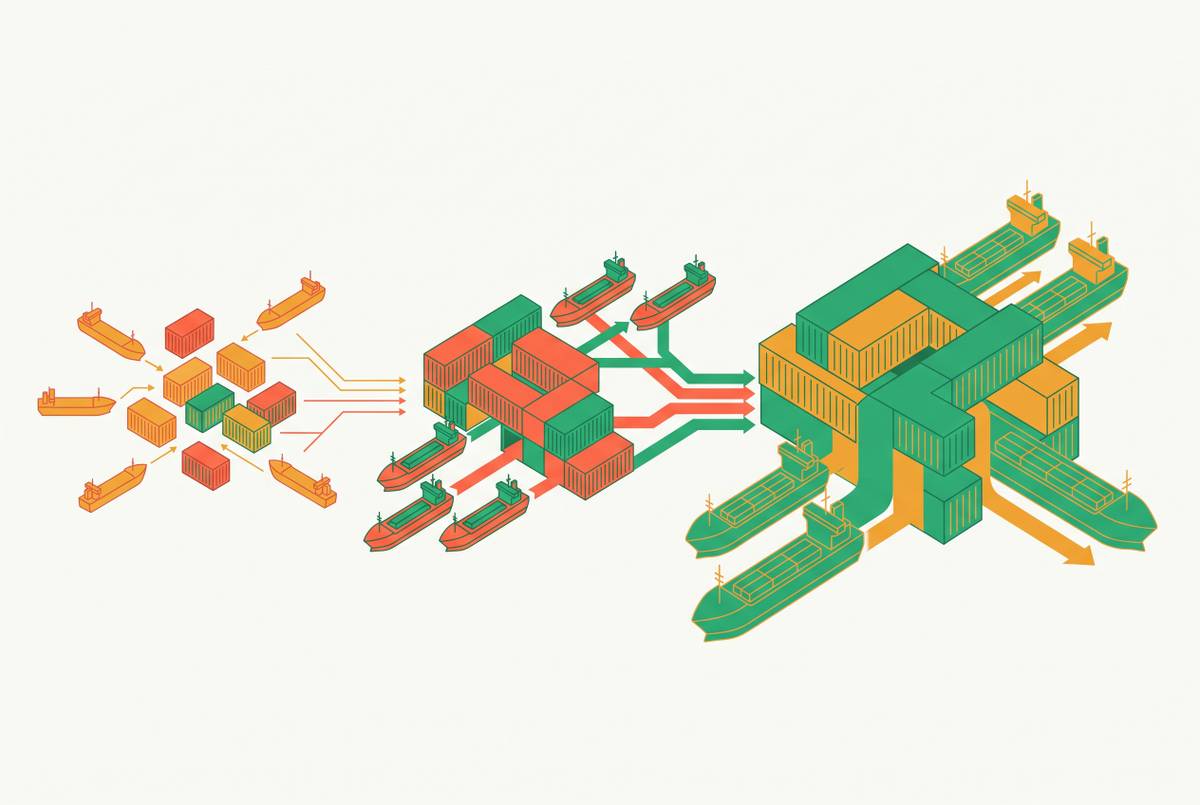
The data exists, but it just doesn't travel.
Analytics live in one platform, onboarding flows in another, CS notes in a third, and the product roadmap somewhere no one checks consistently. Product managers export CSVs, growth teams wait on SQL queries, and by the time anyone assembles a coherent picture, the cohort it describes has already churned or expanded without explanation. Every startup I've watched go through this is drowning in data and dying of thirst simultaneously.
The cost is concrete: patterns that should surface in a week take a quarter to emerge, decisions get made on anecdote rather than signal, and the team that owns onboarding and the team that owns the roadmap rarely share the same view of the same customer. More dashboards don't fix this. Closing the loop between where insight is generated and where decisions get made does.
What Onboarding Data Actually Contains, Signal by Signal
There are three categories of signal living inside a well-instrumented onboarding flow, and most teams read none of them consistently.
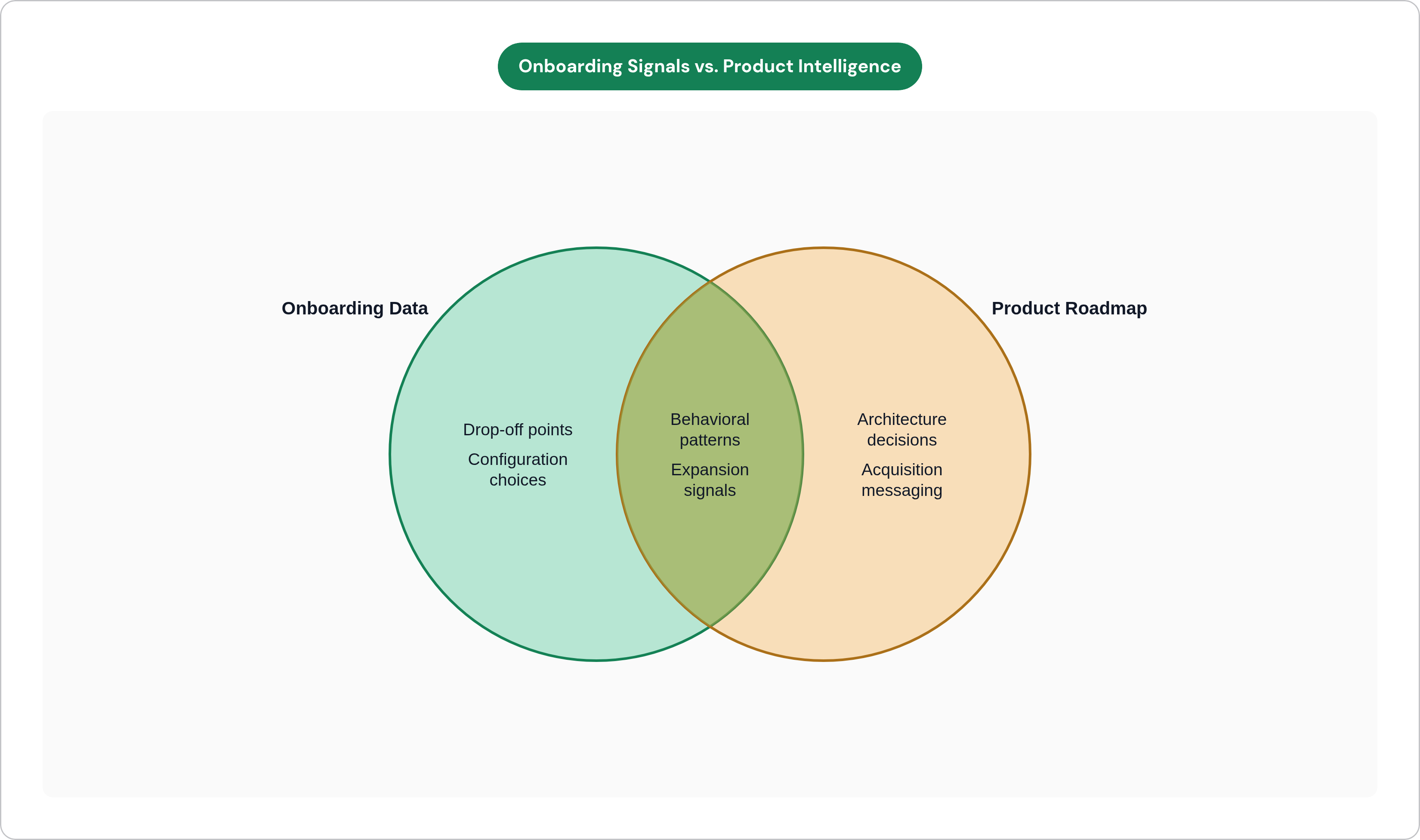
Behavioral signals are the most visible and, paradoxically, the most ignored. Drop-off points show where clients stop; above-average time-on-step reveals confusion that nobody voiced. Feature activation in week one versus features clients never find at all is one of the clearest maps of the gap between your product's self-image and its actual utility.
Language signals are subtler. The words clients use on intake forms, before your onboarding copy has shaped their vocabulary, are a direct read on how they frame their own problem. The questions they ask during onboarding calls expose expectation gaps stated plainly, before clients have learned to stop asking.
Configuration signals are the most diagnostic. What clients set up immediately and what they skip entirely is a proxy for their actual use case versus the one you assumed they had. Where clients deviate from defaults is often the clearest evidence that the product's architecture doesn't match the customer's workflow.
The distinction most teams miss: an onboarding problem and a product problem are not the same thing, and treating them identically is expensive. If the signal is "this step is confusing," a tooltip fixes it. If the signal is "this feature doesn't do what I expected," no amount of onboarding polish resolves it; that signal belongs on the product team's desk. Most teams route both to the onboarding function and wonder why the same friction keeps recurring.
How Userflow Turned a Behavioral Pattern Into a Roadmap Decision
Userflow didn't run a user research study, commission a quarterly survey, or convene a working group. They noticed, in their onboarding behavior data, an unexpected influx of engineers signing up alongside a consistent behavioral pattern: technical users gravitated toward AI features and actively resisted guided flows, preferring self-directed exploration over curated walkthroughs.
That observation could have stayed in a dashboard. Instead, Userflow redesigned onboarding specifically for technical users, building AI-focused content, shorter setup paths, and faster routes into advanced functionality. More consequentially, it reshaped roadmap prioritization, not just the onboarding experience, but what the product emphasized next.
The insight required no new research infrastructure. It was already present in how users moved through the product. What made it actionable was a team willing to treat behavioral patterns as product intelligence rather than onboarding metrics. Any team should be asking not whether signals like this exist in their onboarding data, but whether there's a system in place to read them before they go stale.
Turning Onboarding Patterns Into Leading Indicators for Retention and Expansion
Early onboarding behavior predicts downstream outcomes, which clients reach activation, which churn quietly, which expand without prompting, like a weather system that formed weeks before anyone checked the forecast. These aren't random distributions. They correlate with specific behaviors in the first two to four weeks, and the teams that identify those correlations stop being surprised by churn and start seeing it coming.
Every team I know that lacks metrics connecting onboarding behavior to revenue outcomes faces the same problem: when retention improves or churn falls, they have no record of why, no way to replicate it, and no defensible story for the board. The work happened; the learning didn't.
A well-instrumented onboarding function surfaces four categories of forward-looking signal:
- Which configurations or feature activations correlate with upsell six to twelve months later
- Which onboarding behaviors reliably predict disengagement before the client says anything
- Which customer profiles activate fastest, and what that implies about where to focus acquisition
- Where clients expected functionality that doesn't exist yet, which is a prioritized product wishlist generated without a single survey
The gap between knowing this is possible and actually capturing it is a systems problem. The ambition is usually there.
Why Most Teams Can't Act on the Data They Already Have
The bottleneck is rarely data volume. Most teams have more onboarding data than they're reading; the bottleneck is the speed and structure of interpretation.
Three barriers compound on each other. Tooling fragmentation means the insight is spread across CRM, onboarding platform, product analytics, and CS notes, with no single owner seeing it whole. Ownership gaps mean onboarding owns the process, product owns the roadmap, CS owns the relationship, and the signal crosses all three without clearly belonging to any of them. Latency means that by the time onboarding data reaches the product team through a quarterly review, the cohort it describes has already resolved itself one way or another.
The people closest to the onboarding data, your CSMs and onboarding specialists, are also the people with the least capacity to analyze it systematically. They're busy running onboarding. Expecting them to also synthesize behavioral patterns across cohorts and route product-relevant signals to the right owner is a structural problem dressed up as a resource allocation problem.
Building the System That Closes the Loop Between Onboarding and Product
The core design requirement is simple to state and difficult to execute: the insight has to reach the right person in time to be acted on.
A working loop starts with signal definition. Decide in advance which onboarding behaviors are worth tracking and what each one means. Drop-off points, activation milestones, support triggers, and configuration choices all mean different things; treating them as equivalent produces noise. From there, structure intake and behavioral data so it segments by customer type, use case, and outcome rather than blending everything into an aggregate average that obscures anything interesting.
Then build the habit, or the automation, that sends product-problem signals to the PM, onboarding-problem signals to the CS lead, and expansion signals to account management. Keeping everything in a shared inbox is where signals go to die. Finally, establish a standing review, weekly or biweekly rather than quarterly, where onboarding patterns sit alongside roadmap priorities as a recurring agenda item rather than an occasional retrofit.
AI fits naturally into two stages of this loop: pattern detection across large client cohorts, surfacing anomalies a human reviewer would miss at volume, and automated tagging of intake language into product-relevant categories, removing the manual step that most teams skip because it's tedious and nobody owns it.
What This Looks Like Inside a Small or Mid-Sized Operation
The enterprise version of this involves a dedicated data team, a product analytics platform, and a formal quarterly insights review. Most SMBs have none of those things, and they don't need them.
What SMBs do have: direct access to client conversations, a short chain between the person running onboarding and the person making product decisions, and enough volume to see patterns without sophisticated tooling. Twenty onboardings a month is more signal than most teams are actually reading. The constraint is the system, not the data.
A practical starting point for a team of ten to fifty people runs in sequence. Instrument one bottleneck first: the specific step where clients most often stall or call for help. Tag every intake form response with the client's stated goal in their own language, not your internal category label. Embed one standing question in every onboarding call: "What did you expect this to do that it doesn't yet?" Then route those answers somewhere the product owner will actually see them, on a cadence short enough to act on.
For a small team, the bottleneck isn't ambition. Running onboarding and systematically analyzing it at the same time, without burning out the two people responsible for both, is genuinely hard. AI tooling built around the onboarding function can automate intake tagging, surface behavioral patterns across cohorts, and route product-relevant signals to the right owner without adding headcount. The same underlying approach applies whether you're an insurance broker drowning in manual data entry or a SaaS startup where your head of CS is also your de facto product researcher.
The Compounding Return When Onboarding Intelligence Becomes a Standing Input to Product Direction
The immediate return is faster identification of onboarding friction and fewer clients who churn quietly before anyone gets a chance to respond. That part is relatively straightforward to measure.
Downstream from that, the product roadmap gets shaped by what clients actually attempt rather than what the team assumed they'd want when the product was originally designed. These two things diverge faster than most teams expect, and the divergence compounds quietly until a competitor closes the gap for you.
Further out still is where the real ceiling shifts. New service lines emerge from patterns in what clients asked for but couldn't find. Pricing and packaging get shaped by which configurations clients reach independently versus which require hand-holding. Acquisition messaging gets grounded in the language clients used before your onboarding copy shaped them, which is almost always more persuasive than the language your marketing team invented.
The team that builds this ends up with something more durable than a better onboarding process. Onboarding becomes an early-warning system for churn, a standing source of product intelligence, and a compounding edge over competitors who are still treating it as a checklist to get through before the real work starts. One traced churn event, connected back to a signal sitting in week-one behavioral data the whole time, tends to be the moment a team stops treating onboarding analytics as a nice-to-have. After that, the case for building the loop properly makes itself.