Insurance Client Needs Assessment Using Policy Renewal Data
Brokers can spot underinsured clients by reading renewal data they already have.

A renewal file is a decision point. It's a running record of how a client's risk changed over time, provided somebody actually opens it before the week it's due.
Inside a typical file: coverage history (what got added, dropped, or adjusted at each renewal), a premium trajectory with reasons attached to it, claims tied to specific policy periods, midterm endorsements and riders, payment behavior (late payments, lapses, reinstatements), and a log of every call the client made and what they asked about. None of that is noise. Read against the client's actual business or life situation, each item is a signal. Most brokers are sitting on a stack of them they've never once cross-referenced.
That's inattention mislabeled as something else. It's plumbing. Coverage history lives in the AMS. Claims data sits in a carrier portal. Payment behavior shows up in a billing system. Communication history is scattered across email threads and call notes nobody tagged. There's no single view and no prompt to pull one together outside the renewal window, so the synthesis never happens. Nobody sits down once a quarter and asks what the file is actually saying.
The gap shows up hardest in small business books. The Hiscox Underinsurance Report 2025 found 77% of small businesses remain underinsured, and the brokers serving that segment are frequently sitting on the exact data that would have caught it. They're just reading it backward: asking what happened last year instead of what it predicts about next year. That's the whole failure in one sentence. Wrong direction, right data.
The signals in renewal data that point to unmet coverage needs
Six patterns show up again and again, and each one says something specific.
Coverage stagnation. A client whose limits haven't moved in three or more renewals while revenue or property value kept climbing is quietly sliding into underinsurance. Check the premium-to-revenue ratio across renewal years if the financials are on file, and look for endorsement activity that simply stopped. Flat coverage on a growing business is a gap forming in real time. It's a gap with a delay built into it.
Claims clustering. Two or more similar claims within a policy period, or across consecutive renewals, point to an exposure the current policy design isn't handling. Map claims against coverage type and find where the client is thin exactly where the claims keep landing.
Midterm endorsement requests. A new vehicle, a new location, a new hire added mid-policy means the business is moving faster than the annual review cycle can track. Treat the endorsement log as a growth proxy. A client adding assets midterm needs a renewal conversation that starts earlier and covers more ground than last year's did.
Payment behavior shifts. A client who always paid on time and suddenly pays late, or asks for an installment plan for the first time, is signaling cash pressure. That's also the moment to check whether restructuring coverage could ease cost without opening a gap in it.
Coverage drops at renewal. A client who removes a rider or declines an offered endorsement might be price-sensitive, or might not understand what they just gave up. Flag every dropped item for a needs conversation, not a retention call dressed up as one.
Silence. A client who's never called, never filed a claim, never asked for a change is either genuinely happy or completely checked out, and those two states call for opposite responses. Silence is also the most common profile among clients who leave quietly at renewal. No fight, no complaint, just gone.
None of these six require new data collection. The information is already in the file. What's missing is a habit of reading it that way.
When these signals go unread: what churn data reveals about missed intervention windows
Verisk reviewed 154 million policy records from 2022 through 2025 and found national personal auto retention fell 3.2% in 2024. Its conclusion was blunt: companies that wait until the end of a policy term to try to keep a customer are less likely to keep that customer. Waiting is the failed strategy here, not whatever pitch gets made once someone finally calls.
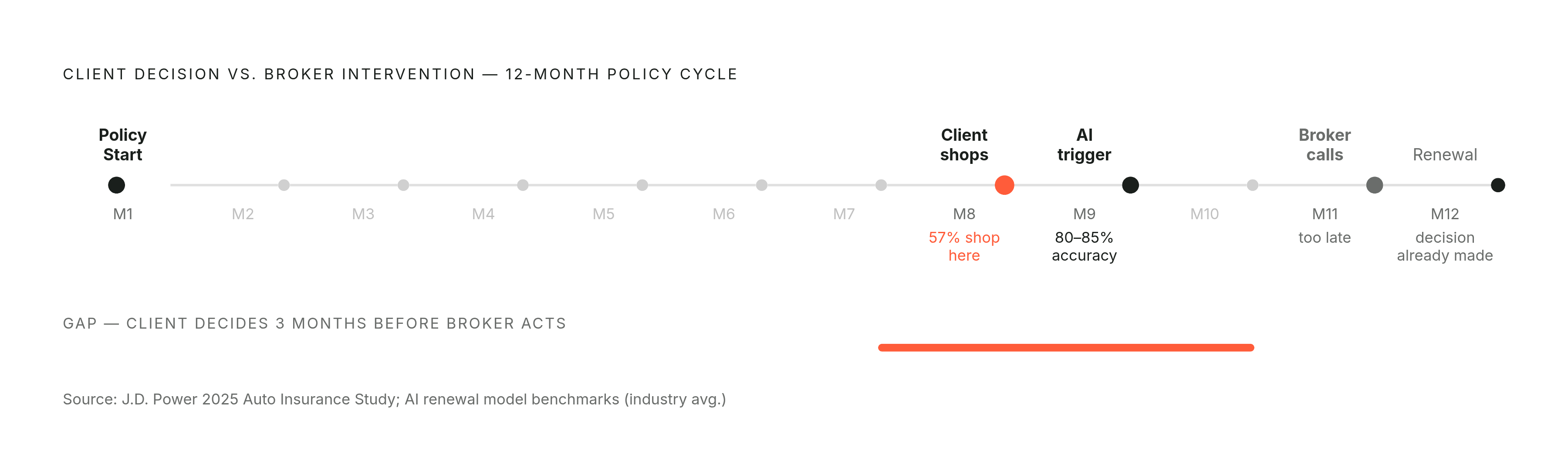
Headline retention numbers hide how thin the margin actually is. Personal lines retention is around 84%, commercial around 86%, numbers that look fine on a dashboard until only 51% of high-value customers say they'll definitely renew. Meanwhile 57% of auto policyholders shopped their coverage in 2025, up from 49% the year before. The shopping window has moved into the middle of the policy term. It isn't a renewal-season event anymore.
So if a client is comparing quotes at month eight of a twelve-month policy, a renewal conversation that starts at month eleven is already too late to matter. The client made the decision before the broker even opened the file.
And the fix pays for itself fast. Retaining a customer costs 5 to 9 times less than acquiring a new one, and a 5% lift in retention can raise profits anywhere from 25% to 95%. Most of the losses behind those numbers don't come from bad service. They come from nobody reading the signal that was sitting in the file the whole time.
Building a systematic renewal data review into the broker workflow
The fix is structural: replace the calendar-triggered renewal conversation with a signal-triggered one.
Set a 90-day pre-renewal trigger. AI-based renewal models hit 80 to 85% accuracy predicting non-renewals 90 days out, climbing to 88 to 92% at 30 days. Ninety days out is where intervention is still cheap and still works. A manual shop can approximate this without any software: pull the file at 90 days and run it through the six signal categories above.
Build a client signal card. One page per client. Coverage trajectory, claims history, midterm changes, payment pattern, last outbound contact. One view before the call beats a scavenger hunt across four systems the morning of the renewal meeting.
Segment clients by signal profile before outreach. A client with stagnant coverage and rising revenue needs a different call than one who dropped a rider last year. Segmenting lets a broker spend real time on the accounts that need it, instead of running the same script on everyone in the book.
Document the needs assessment, not just the renewal outcome. Record which signals got reviewed, what gaps came up, what got offered, what got declined. That record compounds. Next year's review starts from something richer than memory.
An agency running hundreds of renewals a year can't do this by hand without either hiring a stack of new people or automating the signal-reading itself. Pick one. There's no third option where a spreadsheet quietly handles it.
How AI turns this signal-reading process from a manual review into a continuous feed
A manual quarterly pull is a snapshot. AI turns the same process into a live feed across the whole book, not just the accounts due for renewal in the next 90 days.
It watches continuously. A midterm endorsement, a payment flag, a claim: each one surfaces the moment it happens instead of waiting for someone to remember to pull the file. Renewal retention systems built for this score each client on a 0-to-100 renewal probability and name the specific driver behind an elevated score, whether that's price sensitivity, a coverage gap, dissatisfaction over a claim, or a shift in the broker relationship. Some go further and suggest the retention move to make.
The accuracy bands cited earlier, 80 to 85% at 90 days climbing to 88 to 92% at 30 days, give a broker real lead time instead of a two-day scramble before a policy lapses. AI-driven CRM tools that predict customer needs and preferences are an active trend in insurance tied directly to retention gains, and AI-personalized retention programs have been shown to reduce churn by 15 to 25%. Put a number on that: a $500 million premium book running 15% annual churn, cut by 20%, keeps roughly $15 million in premium that would otherwise have walked out the door.
None of this replaces a broker's judgment or a relationship built over a decade of renewals. It replaces the guessing about where to spend the next hour. McKinsey puts AI-driven gains in insurance renewal workflows at up to 30% lower processing cost and a 10 to 15% bump in customer satisfaction, gains that come from better-timed conversations, not scripted ones.
What brokers and agencies can realistically deploy today, and how fast
The tooling large carriers built with eight- and nine-figure internal budgets is now sold off the shelf, often starting under $5,000 a month. Access was the barrier, not capability, and that barrier is gone.
A small or mid-sized agency can put three things in place without ripping out its existing stack. Renewal scoring layered into the AMS it already runs, so at-risk accounts get flagged automatically. Conversational AI that handles renewal outreach calls and routes anything flagged high-risk straight to a human broker (platforms like Sonant, an Applied Epic Certified Integration Partner, work this way). And a signal dashboard that pulls midterm changes, claims, and payment flags into one screen instead of four.
Hiring for this in-house is slow. A full-time AI engineer search is a slow process, an eternity for an agency watching renewals slip through the cracks in the meantime. An embedded or fractional engineer can get up to speed far faster, identifying the highest-leverage bottleneck in the renewal workflow, building a production system around it, and staying on as it compounds. What starts as a renewal-risk alert has a habit of turning into a cross-sell trigger or a service line the agency never had headcount to run before.
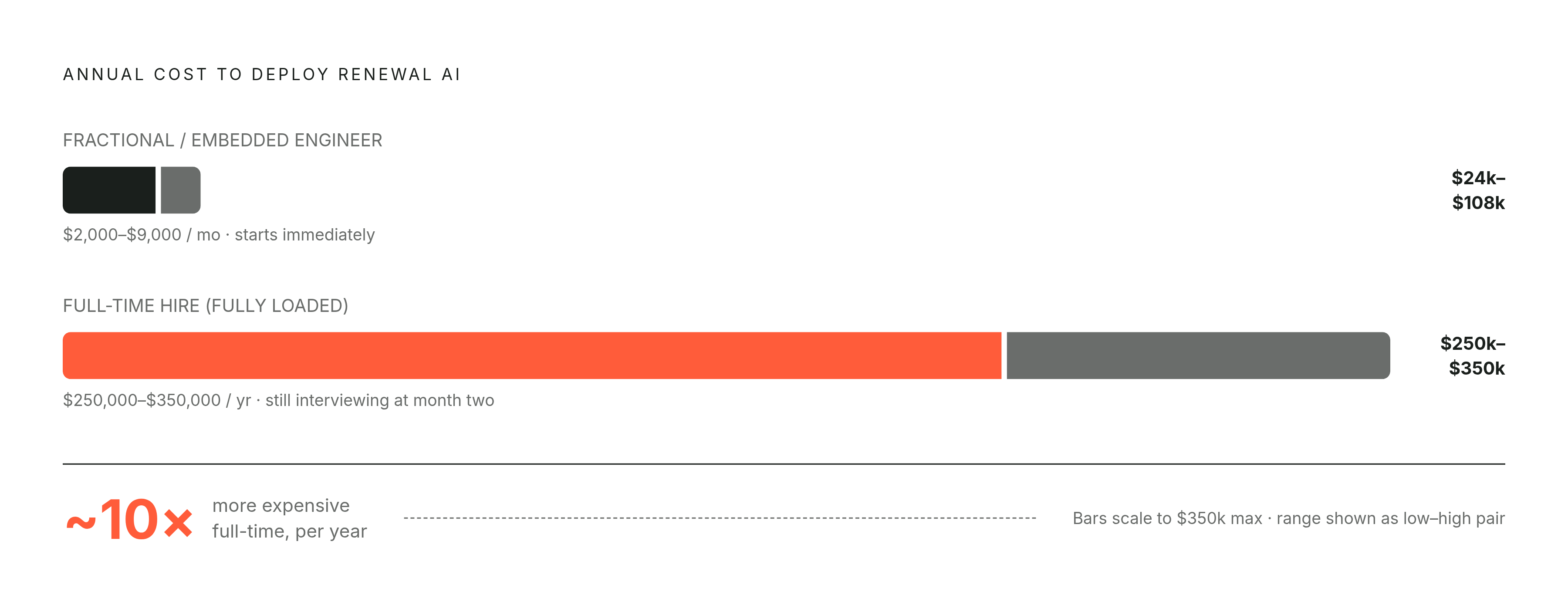
The cost math favors the fractional route, and it isn't close. $2,000 to $9,000 a month against $250,000 to $350,000 a year fully loaded for a full-time hire, and the fractional engagement produces output while the full-time search is still stuck in its second round of interviews. Agencies that set clear KPIs into these deployments have reported reaching ROI within months rather than years. As a benchmark for what a first production system delivers: one documented insurance and finance engagement cut manual data entry by 80%, and a separate logistics and export engagement saved over 160 hours a month, both before any compounding effects kicked in.
What changes when renewal data becomes a continuous needs assessment, not just a retention tool
Calling this a retention play undersells it. A broker reading renewal data systematically is generating a paper trail for the next dispute. That's just the byproduct. What's actually running is an ongoing needs assessment, quietly, in the background of every account in the book.
A client whose endorsement log shows three straight years of new business assets is a candidate for a coverage review, a commercial umbrella conversation, or a referral into a specialty line the agency doesn't usually push. A client with two similar claims two years apart is a candidate for an actual risk management conversation, the kind that turns a broker into an advisor instead of a renewal clerk. And a whole segment showing coverage stagnation is a warning sign for the book as a whole. It's a market signal telling the agency exactly where its own book is underserved.
The effect compounds. Every renewal handled as an assessment instead of a transaction leaves behind a richer client record, so next year's review starts from a better baseline without costing the broker more time per client. The annual check-in stops being the main way an agency learns about its clients and becomes one input among many feeding a continuous stream.
That's the ceiling this removes. A five-person agency reading its renewal data this way can carry a bigger, messier, more complex book than a ten-person agency still working the file once a year and calling it thorough.