Purchase Order vs Invoice Workflow in Small Service Firms
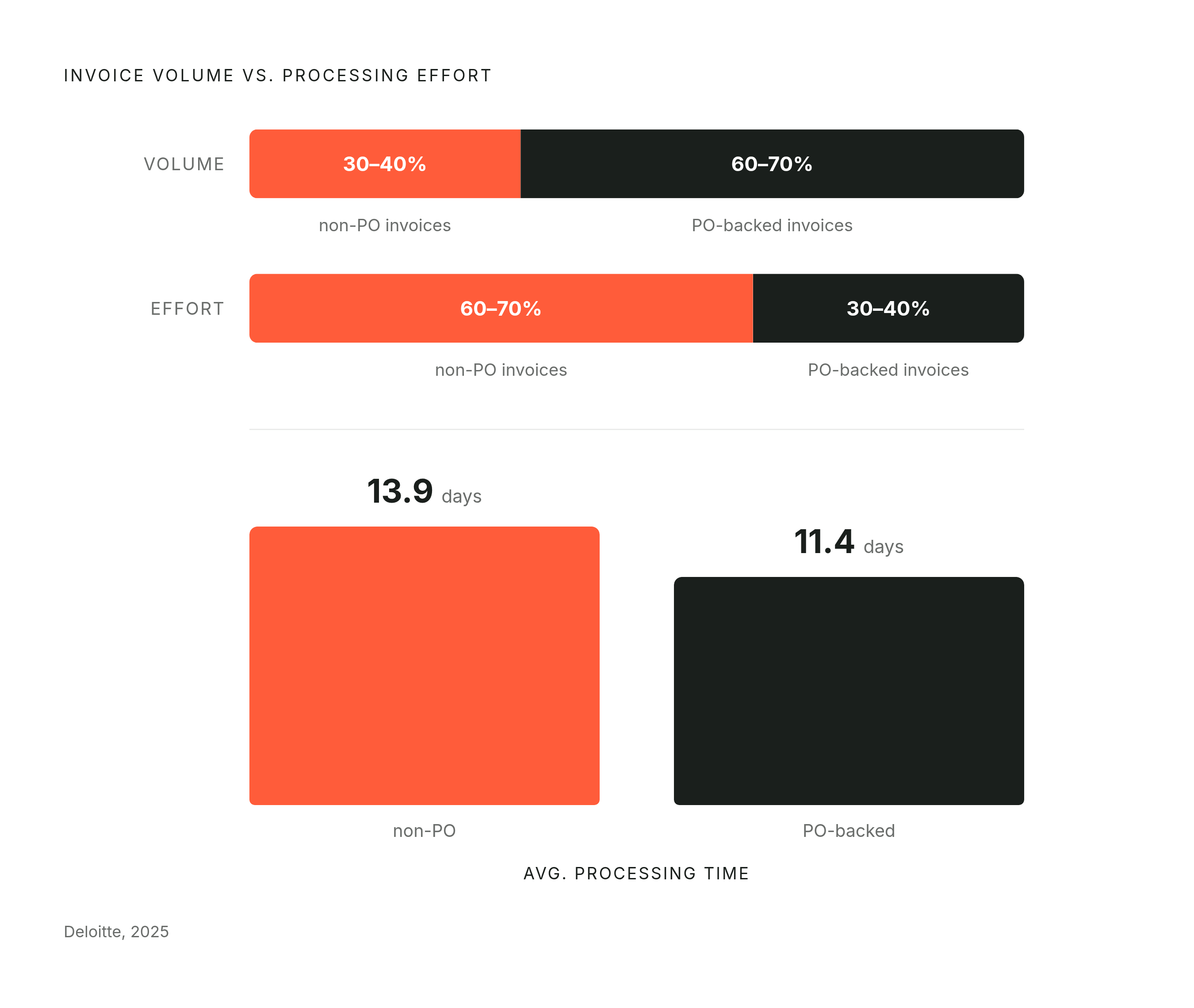
Non-PO invoices consume most of AP time despite being a minority of volume.
A purchase order locks in what a service firm agreed to buy, and at what price, before anyone lifts a finger. An invoice shows up after the work is done and asks to be paid. Between those two documents sits a chain of approvals, matches, and judgment calls, and when that chain breaks, the symptoms show up in cash flow, not just the ledger. Small service firms feel this more than most, because so much of what they buy never generates a PO to begin with. Understanding how the sequence is supposed to run, and where it actually breaks, is the starting point for fixing it.
How the sequence runs from approved PO to cleared payment in a service firm
The textbook version goes like this: purchase order, sales order, service delivery, invoice, payment. Five stages, each one a handoff. Someone with budget authority signs off on the PO before a vendor gets engaged. The vendor confirms scope and turns that PO into an actual delivery plan. The firm checks that the service showed up as specified, then the invoice comes in and gets checked against the PO for quantity, price, and scope. If something doesn't line up, a person has to make a call before money moves.
That last check has a name: the three-way match. PO, delivery confirmation, and invoice all have to agree before payment clears. Run it well and it disappears into the background, which is the whole point of a good control. The trouble starts the moment a stage gets skipped or badly documented, and for service firms that happens constantly, because a lot of what they buy (consulting, freelance work, travel, subscriptions) never touches a PO in the first place.
Why non-PO invoices are the highest-friction category for service businesses
Service firms buy differently than manufacturers or retailers do. Consulting fees, SaaS subscriptions, freelance invoices, travel expenses: all of it sits outside a PO workflow, because the purchase happens before any order can be raised, a flight is booked, a contractor hired for a two-week sprint. These invoices land with no reference number, no pre-approved budget line, no standard format. Whoever runs AP has to build context from scratch every time, chasing down what was bought, who approved it, and why, with nothing on paper to start from.
Deloitte's 2025 benchmarking study on finance operations found that non-PO invoices make up 30 to 40% of invoice volume but eat 60 to 70% of AP processing time. A minority of invoices soaks up most of the effort. Ardent Partners puts non-PO invoices at an average 13.9 days to process, against 11.4 days for PO-backed ones. Two and a half days compounds quickly when it repeats across dozens of invoices a month; for teams carrying a heavy non-PO load, GL coding alone can consume 133 to 200 hours monthly. Quadient's 2025 numbers put invoice exceptions at the top of the complaint list for 53% of AP teams, and missing-PO invoices are usually the biggest driver of that number.
What manual processing actually costs when these workflows stay unmanaged
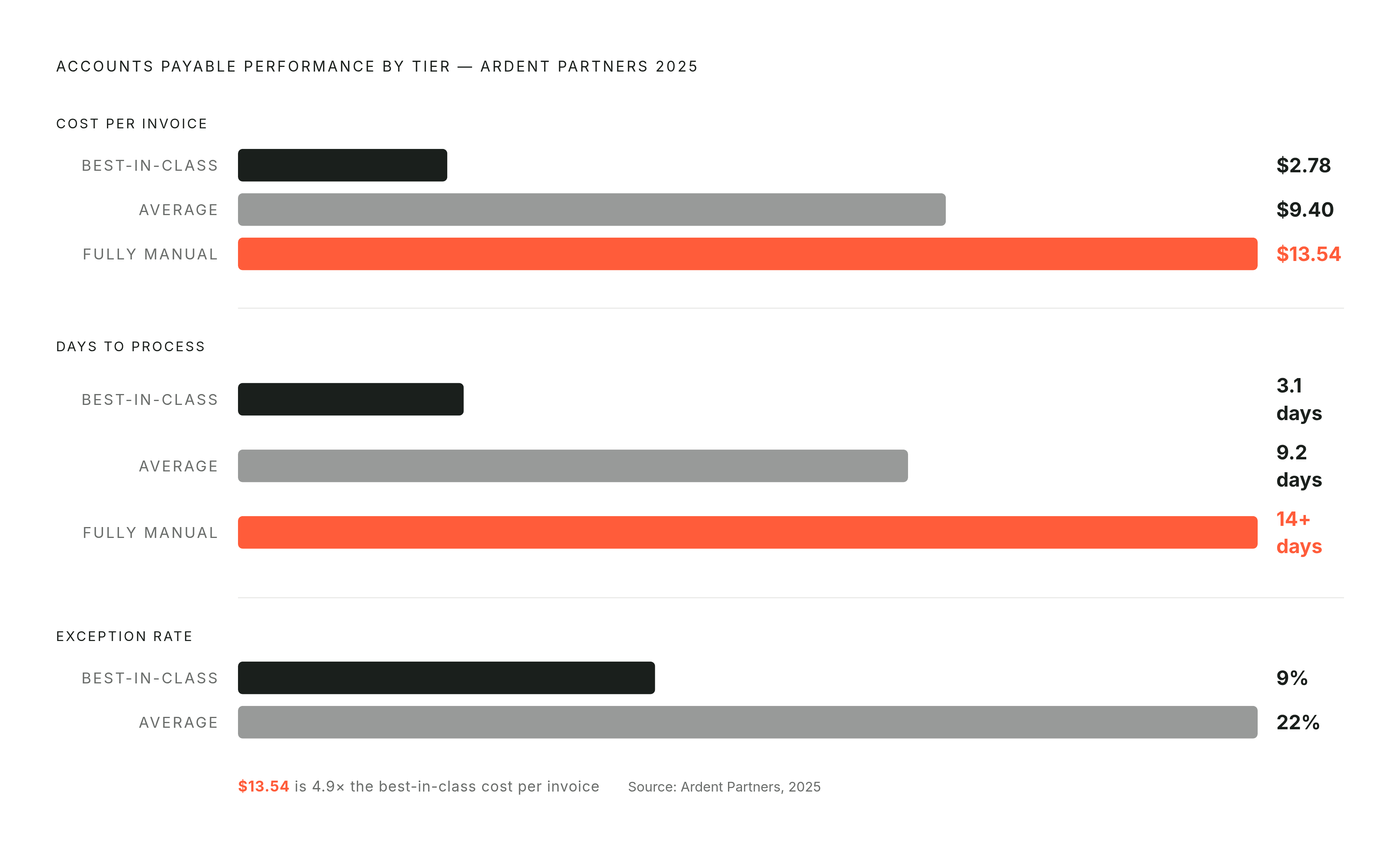
Start with the spread, because the average hides the real story here. Ardent Partners' 2025 data puts best-in-class AP teams at $2.78 and 3.1 days per invoice, while the average organization spends $9.40 and takes 9.2 days to do the same job. Fully manual shops run worse odds still: Ardent Partners AP Metrics That Matter 2024 put that number at $13.54 per invoice, roughly 4.5 times what top performers spend, almost all of it labor spent matching and chasing exceptions.
Exception rates follow the same split. Best-in-class teams sit at a 9% exception rate; the industry average runs 22%. For a small firm processing even a modest volume, that gap eats a real chunk of somebody's week, and it's rarely the same week twice. The damage spreads beyond the back office. Late payments remain a persistent problem for small businesses, and slow approval cycles only compound the exposure. Slow approval cycles delay outbound billing and inbound collections at the same time, so a bottleneck on one side of the ledger becomes a cash crunch on the other. Call it what it is: a workflow problem wearing an accountant's clothes.
Where the real work happens: the approval and reconciliation decisions inside the workflow
The workflow is a stack of judgment calls, and each one needs the right person paying attention at the right moment. Does the invoice match the PO within a reasonable tolerance? If not, who signs off on the variance? Is this invoice a duplicate that already got paid last quarter? Which GL code does a non-PO expense even belong to, and who decided that?
In a small firm, all four questions usually land on one desk: the owner, a bookkeeper, an office manager already wearing six hats. That's a single point of failure baked right into the org chart. Invoices stall in approval routing because the one person who has to sign off is client-facing, or traveling, or just buried under something else. Month-end reconciliation makes it worse, since unmatched invoices have to get untangled against bank statements and delivery records all at once, on a deadline nobody moved to accommodate. Per-invoice time under manual conditions runs long, mostly judgment and tracking people down, not typing.
The failure patterns repeat across firms: invoices approved with no PO because the PO step got skipped at the point of purchase, scope creep on an engagement generating charges nobody pre-approved, a vendor submitting the same invoice twice across billing cycles, GL miscoding that quietly distorts the P&L until somebody untangles it at year-end. Fixing this requires changing which decisions need a human at all.
How AI changes which parts of the workflow require a person
AI takes over five specific jobs in this workflow, and none of them are glamorous. It pulls data off PDFs, scanned paper, and email attachments, then sorts incoming invoices into PO-backed or non-PO on its own, which cuts down on misclassification. It suggests and corrects GL codes based on vendor history and past spend. It runs the three-way match with tolerance that adjusts itself, flagging real discrepancies instead of every two-dollar rounding difference, and it catches duplicate invoices and fraud signals before a payment goes out the door.
Those five tasks consume a large share of AP labor under manual conditions — AI is eating the bulk of the job. Touchless processing, invoices that clear with zero human involvement, reached 52.8% in 2025, up from 47.2% the year before. For non-PO invoices specifically, AI has been associated with processing time reductions of 70 to 80% while improving coding accuracy and making audits less of a headache. In practice, this looks almost boring: someone forwards an invoice to a dedicated inbox or snaps a photo of a paper receipt, the system pulls vendor, date, and amount, checks it against the bank feed, and only the genuine exceptions land on a human's desk. The job changes shape, shifting from processing everything to reviewing genuine exceptions the system escalates.
What the operational gains look like when the workflow is rebuilt around AI
Processing time compresses dramatically once AI handles capture, matching, and exception triage, with reported reductions reaching 93%. Per-invoice cost drops from the manual range toward the sub-$3 territory best-in-class teams already occupy, and duplicate-payment losses can fall by 80 to 95%. A team running this way handles a lot more volume without adding a single hire. The same people shift to resolving exceptions and managing vendor relationships.
For receipt and invoice capture specifically, AI reduces manual entry and cuts out the mistakes that come with entering numbers at midnight because that's when the pile finally got small enough to face. Payback shows up faster than most small business owners expect: documented rollouts put median payback around 4.2 months. The cash flow effect compounds from there, since faster approval cycles mean faster payment decisions, better capture of early-payment discounts, and fewer late fees. Early-payment discount capture is a recognized contributor to AP ROI for top-performing teams. Firms can handle more volume than one exhausted person could reasonably push through under manual AP. The firm can take on more vendors and messier engagements while the back office keeps pace.
How a small service firm actually moves from manual workflow to working AI system
Start with the process, not the software. Map the current PO-to-payment sequence and find where invoices actually stall, where exceptions pile up, and which decisions are genuine judgment calls versus routine matching that a human can hand off to automation. The highest-leverage target is almost always non-PO invoice intake and GL coding, since that's where the manual hours pile up.
A workable sequence looks like this: pick one intake channel, a single inbox or upload point, for every incoming invoice. Build the extraction and classification layer so AI reads and sorts things on arrival, then connect it to whatever accounting system is already running, QuickBooks, Xero, doesn't matter which, so matched invoices post without anyone re-typing them. Define exception routing clearly: what gets escalated, who owns it, how fast they need to respond.
Deployment used to take six to twelve months before anyone saw results. Firms that focus on one specific workflow instead of a sprawling platform rollout tend to see measurable improvement sooner than those attempting broad simultaneous rollouts. Somebody still has to decide what counts as an acceptable match, what variance triggers a human review, and what the escalation path looks like. AI works better calibrated to how the firm actually runs rather than a generic vendor template. Success here is measured by whether the approval cycle got shorter, the exception rate dropped, and cash flow actually improved, and those three numbers are worth checking from week one.