RFQ Automation for Small Insurance MGAs and Job Shops
Automating intake work frees underwriters and estimators to compete on more business.

RFQ automation for small insurance MGAs and job shops increases capacity through faster data entry. When submission preparation and quote drafting consume the people qualified to make decisions, the inbox sets the limit on growth. When that preparation is automated, the same team can assess, quote and compete for more business while still making the calls on risk and pricing.
Why the RFQ bottleneck is a volume ceiling, not just a time drain
On Monday morning, the inbox holds broker submissions with stacks of attachments, or customer RFQs with drawings waiting to be read. Before an underwriter can assess a risk or an estimator can price a job, someone must open, sort, extract and enter the information. The queue grows even when the people working through it are good at their jobs.
An MGA can quote only the submissions that reach an underwriter in a usable form. A job shop can compete on speed only when its estimator has time to turn the incoming documents into a quote. Adding requests therefore adds preparation work, until the business must add headcount or turn work away.
What the intake work actually consists of, across both contexts
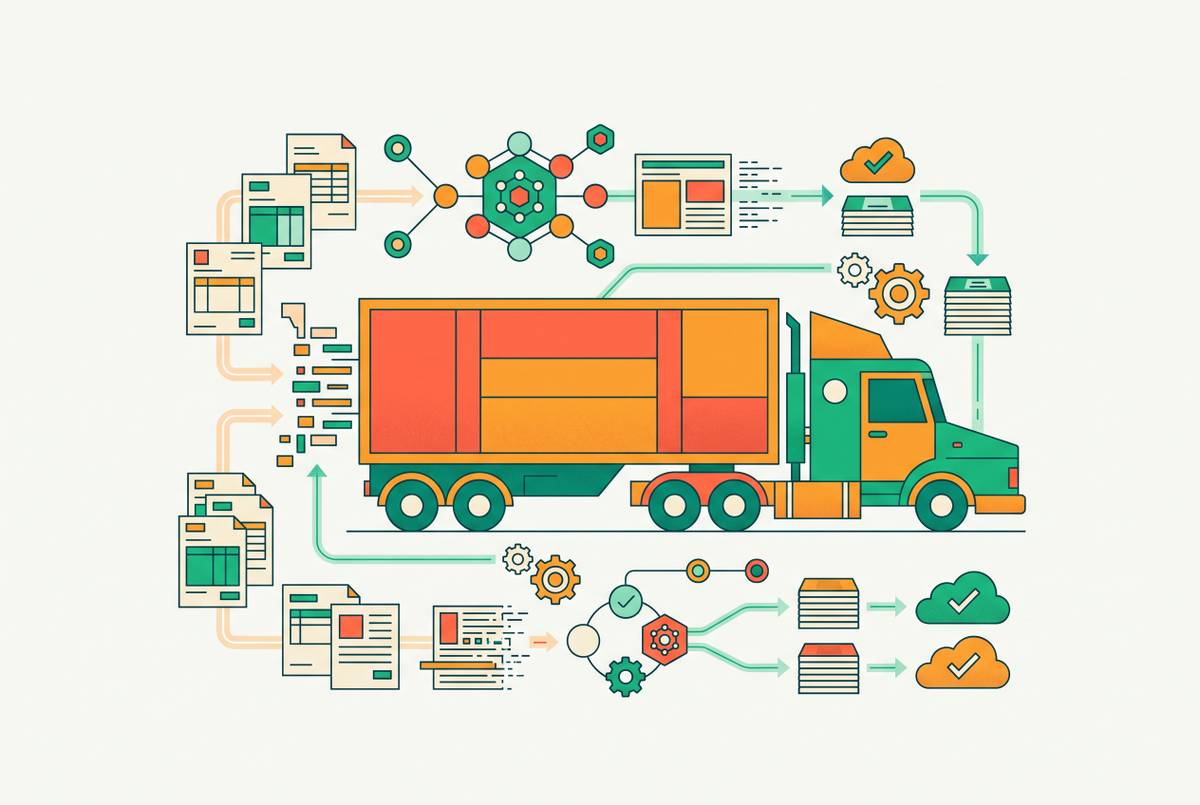
For an MGA, a commercial submission can contain ACORD applications, statements of value (SOVs), loss runs, financial statements and certificates of insurance. FurtherAI describes these documents arriving in different formats from thousands of independent agencies. Someone opens the email, identifies and sorts the attachments, extracts fields and enters them into policy administration or CRM. They then check for duplicates, compare the submission against appetite, flag missing items and assemble the file. Only then does the underwriter have the material needed for a risk decision.
For a job shop, the sequence begins with an RFQ arriving by email or PDF. The estimator reads the drawing, identifies material specifications and tolerances, finds comparable past jobs, builds a time-and-material estimate and enters it into a quote document. Customer drawings are no more uniform than broker submissions. Past-job pricing intelligence can remain locked in folders, just as exposure information remains trapped in an MGA’s PDFs and spreadsheets. FurtherAI calls that inaccessible information “dark data”.
Insurance RFP responses add a coordination burden to the document work. They require input from underwriting, compliance, claims, legal and technology teams. A prepared draft still has to travel through those reviewers, and the slowest review limits completion.
Why rules-based automation has not solved this, and what AI agents do differently
Optical character recognition (OCR) and robotic process automation (RPA) can support standardized templates, but unfamiliar documents disrupt that arrangement. When each new format needs a new template, maintaining templates takes time away from processing work.
The three kinds of automation here are deterministic automation, AI extraction and classification, and AI agents. Deterministic automation does work with fixed steps, such as routing and record creation. AI extraction takes data from unstructured documents and puts it into structured fields with confidence scores. Agents carry out multi-step tasks, interpreting the documents, checking the results and moving the work toward completion. When information is unclear, the agent can ask for clarification.
For insurance intake, that means progressing from attachment classification through extraction, validation, enrichment and triage to system population. For a job shop, it means reading the RFQ and drafting an estimate for review instead of asking the estimator to start from scratch. Tribble describes how this can also work for insurance RFPs, where AI uses compliance documentation to write jurisdiction-aware responses with citations. Low-confidence answers go to compliance for human review rather than becoming unverified assertions in a finished response.
What the automation actually touches in an MGA's submission workflow
A submission enters the automated workflow when it is forwarded to the agent. The agent identifies ACORD forms, SOVs and loss runs, extracts the required fields and converts the SOVs into a standardized format. People no longer have to do re-keying at this first stage. The next stage checks for inconsistencies, including mismatched coverage dates and missing documents. Anomalies are flagged for underwriter review, while third-party data fills gaps in the submission.
Once the information is assembled, clearance and triage determine how the file should proceed. The system checks underwriting guidelines and detects duplicate submissions, including the same risk sent by two brokers from different offices. It then prioritizes the highest-value risks so they reach underwriters first. Clean, structured data is written into policy administration, CRM and rating platforms. The workflow produces a decision-ready file.
People still handle pricing, risk judgment and the broker relationship. That boundary matters because the first gains come from intake, extraction, duplicate detection and appetite triage. RFP response automation divides the work in much the same way: it writes a first draft with confidence scores and source citations and sends uncertain compliance answers to the compliance team.
What the automation actually touches in a job shop's quoting workflow
For a job shop, the first useful automation begins with customer PO and RFQ entry from email and PDF. Quote intake follows, with the agent reading the incoming drawing or RFQ, identifying material specifications and tolerances, and finding comparable past jobs in the system. From that information, it produces a draft estimate. The estimator reviews and approves the draft. As in the MGA workflow, the handoff moves from raw paperwork to prepared work.
Human review is non-negotiable for a practical reason. A misread wall thickness or missed tolerance can mean a scrapped job. The agent proposes, and the estimator disposes. The quality of the draft also depends on the records underneath it, so accessible past-job data and clean item data are prerequisites.
After customer entry and quote intake, the next work to automate is supplier follow-ups and expediting, then three-way invoice matching, then NCR and CAPA drafting with quality engineer sign-off. That order puts the work with the fastest throughput gain first. The sensible starting scope is one product family, with the office steps timed from RFQ receipt to sent quote. Choose the bottleneck the timings reveal, even if another task would make a more impressive demonstration.
What actually changes in throughput and win rate when the bottleneck is removed
Tribble describes insurance RFP automation turning multi-day, multi-stakeholder projects into sub-4-hour deliverables. The same team can consequently respond to a much larger volume of RFPs. That increases available capacity. Submission intake also lets the team handle more files when preparation stops holding them up on their way to an underwriter.
More decision-ready files create the opportunity for more quotes and more bound policies. So bind ratio and policy count matter as much as how fast the files are processed. A faster intake process is not the complete result if the additional files never advance through the rest of the pipeline. The outcome has to be visible beyond the inbox.
For job shops, the commercial connection is quote speed combined with competitive pricing drawn from real past-job data. A shop that responds first to a clean RFQ can win more work without adding estimators. OutcomeCatalyst recommends measuring underwriter minutes per submission touched together with quote turnaround, hit ratio and underwriting expense ratio in the MGA context. Those measures separate time released from business gained. They also raise the next question, which is what must work underneath the automation for the gain to hold.
Why most automation projects stall before producing these outcomes
Automation projects often stall at the data layer. An MGA’s policy administration, CRM and rating platforms may hold different versions of the same account. An agent cannot assemble a consistent picture from systems that disagree. OutcomeCatalyst identifies connecting those systems and the inbox before scaling as a prerequisite. In a job shop, three part numbers for one bracket can likewise lead the agent to choose the wrong component with confidence.
Adoption creates a separate failure mode. If the team does not understand what the agent is doing or where human judgment begins, people route around it. Submissions are processed manually in parallel, outputs go uncorrected and the system drifts. Someone must own adoption after go-live, because deployment alone does not settle how the work will be done.
Governance makes that division explicit. At the European MGA Summit 2026, John Dexter, managing principal at Euclid Financial & Professional Risks, said a first step was to put an AI usage policy in writing. It defines what the organization is comfortable letting AI handle and what remains outside its remit. For insurance RFPs, that remit must also account for jurisdiction-specific compliance requirements, since a generic response can be wrong for a carrier in another state. A polished answer is not necessarily an acceptable one.
How to sequence the first 30 days to get to a working system, not a pilot
Week one starts with one workflow and a clock. A job shop maps RFQ receipt to sent quote for one product family and times each office step. An MGA maps one submission type end-to-end and counts underwriter minutes per submission touched. These measurements locate the constraint. The MGA also drafts its AI usage policy during this week, so the permitted scope shapes the build.
Week two addresses the inputs. The MGA checks whether the account data in its policy administration, CRM and rating platforms agrees. The job shop resolves duplicate part numbers and makes sure comparable past-job information is accessible. This work is necessary for the first automation to produce a useful result.
During weeks two and three, one real submission or RFQ goes through the system end-to-end. The team validates accuracy and confidence scores, with compliance answer quality included where relevant. For an MGA producing jurisdictional responses, the compliance team reviews those first outputs. A live document is the test of readiness, rather than a convenient test case selected because it behaves well.
During weeks three and four, the team documents approval gates, automatic routing and the conditions that trigger a human flag. The underwriter or estimator should know exactly what requires review and approval. The rule is to prove the measured bottleneck can be removed in one workflow before expanding to others. An embedded implementation partner fits this task when the need is help connecting data, defining the handoffs and supporting adoption. The first working system then creates structured data that makes the next system faster to build and more accurate from the start.
What becomes possible once the bottleneck is gone
For an MGA, the opportunity is more underwriting decisions and more time for broker relationships with the same underwriters. Capacity can also change which business is worth pursuing. An MGA that can clear and triage twice the submission volume without adding headcount can consider lines or geographies it previously declined on capacity grounds. That business opportunity depends on the deployment's capacity gains. The important change is that preparation no longer makes the decision before an underwriter gets to it.
For a job shop, the estimator becomes the reviewer of drafted quotes rather than the starting point for every clerical step. The shop can respond to more RFQs without a second estimator and compete for work that previously waited too long. The structured data from intake also supports the next workflow, whether that is clearance and triage for an MGA or supplier follow-up for a shop.
SANSA’s place in this work is as the partner building toward that capacity outcome, rather than treating a functioning pilot as the finish line. A five-person MGA team or a three-person estimating office needs a system that fits its data, approvals and daily work. Access to those systems is no longer limited to the largest businesses. With the preparation constraint removed, a small team can take on business that previously lay beyond its reach.