Strategic vs Tactical Planning in Small Business Goal Setting
Linking long-term strategy to daily tasks closes the execution gap most small businesses face.
Small business owners set annual goals every January and lose track of them by March. The goals were not bad and the owner did not lack discipline: nothing connected the goal to Tuesday's task list. Roughly 60% of companies admit they cannot translate strategy into plans tied to daily operations, and only about 30% of strategic initiatives fully hit their objectives, with the gap between formulation and execution cited as the main cause. For a small business, that gap runs wider than it does at a large corporation, since there's no strategy department to catch what the owner misses. That's the whole article, really: a diagnosis of where the gap opens and a case for what closes it.
What strategy means at the small business level
Strategy is a set of deliberate choices about where the business is headed and why, made with the understanding that saying yes to one market or service usually means saying no to another. It is not a mission statement laminated and hung by the front register. Anyone can write "we value excellence" on a wall. Strategy is what happens when the owner refuses to serve a customer segment that would have paid the bills this month because it drags the business away from the segment that pays them for the next five years.
The time horizon runs long, typically three to five years, and the questions are structural: which markets to enter, which services to drop, how to position against the competitor down the street who just undercut every price on the menu. Strategy deals with the big picture, and it's proactive by design, not a reaction to whatever fire started this week.
In a small business, strategy almost always belongs to the owner, because there's no separate executive tasked with "corporate direction" while someone else runs the shop floor. The owner usually is the shop floor. That concentration is not the problem. The problem appears when the strategy stays in the owner's head instead of getting said out loud, in language the team can repeat back on command. A plan that only one person can articulate is a mood, not a plan. It's a mood.
What tactical planning does
Tactics answer how and by when. Strategy answers why. Small businesses lose the thread here constantly, because a full calendar of client work feels like progress even when none of it points anywhere in particular.
The tactical layer runs medium-term, six to 24 months, and it's where OKRs and delivery KPIs actually live. Tactical planning runs reactive by nature: it responds to what's happening right now to keep the strategic plan from drifting off course. A tactic assigns an owner, sets a deadline, and allocates resources against a goal that's already been decided somewhere upstream. It doesn't invent the goal. It executes against one that already exists.
Most owners get this backwards: busy is not the same as aligned. A team can close 40 tickets a week, hit every deadline on the shared calendar, and still have no idea whether any of it moves the business toward the three-year goal the owner mentioned once, at a holiday party, half-joking. Activity feels like proof of progress. It's motion, not proof of progress. It's just motion, not proof of progress.
The three-tier model: how strategy, tactics, and operations connect
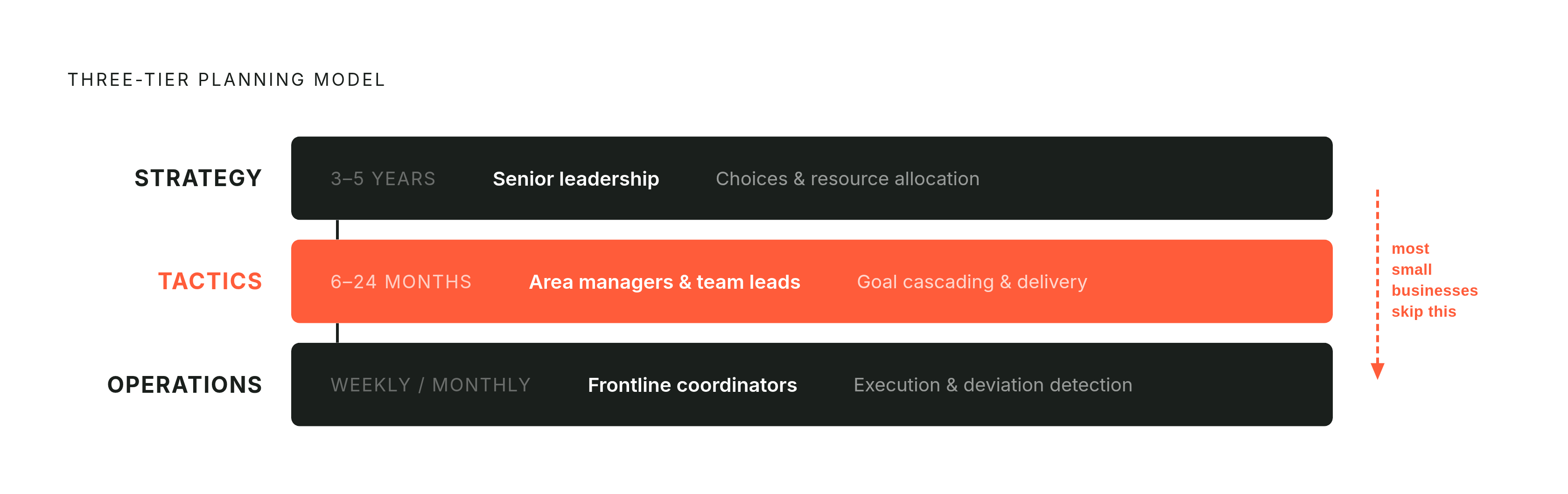
Picture three gears turning at different speeds. Strategy sets the direction, tactics translate that direction into programs, and operations grind out the daily work that makes the programs real. Each gear needs the other two turning correctly or the whole mechanism seizes.
The strategic layer runs on a three-to-five-year horizon, sits with senior leadership (which, again, might be one person and a spreadsheet), and leans on tools like the Balanced Scorecard or a SWOT analysis. Its job is choices and resource allocation, full stop.
The tactical layer runs six to 24 months, sits with area managers and team leads, and uses OKRs and performance dashboards. Its job is delivery capability, making sure strategic goals actually cascade into department-level and team-level action instead of stalling at the top.
The operational layer runs weekly, monthly, sometimes quarterly, and belongs to team coordinators and frontline supervisors. Its tools are unglamorous: PDCA cycles, checklists, standups. Its job is execution discipline, catching deviations before they calcify into a missed quarter.
Where the chain breaks most often in small businesses
Three failure points recur, and each one maps to a tier.
At the strategic level, the failure is rigidity, or its opposite: too many objectives with no clear priority, plus a communication breakdown that leaves each team member running a private interpretation of "grow the business." At the tactical level, goal cascading fails. The strategic objective never gets broken into department-sized pieces, so sales thinks the priority is volume while operations thinks it's margin, and both are technically right, which is its own kind of wrong. At the operational level, execution turns inconsistent because there's no feedback loop, so deviations pile up quietly until the disconnect between plans and execution causes a missed quarter nobody saw coming.
The small-business version of this failure looks different from the corporate one, and it's worse. The owner sets a strategic goal in January, then jumps straight to operational tasks, skipping the tactical layer. No department goals, no OKRs, no bridge. Just a strategic aspiration on one end and a to-do list on the other, with nothing built to connect them. This produces one of two familiar pictures: a team that's tactically busy but strategically adrift, or an owner with total clarity on strategy and a team with no structured path to execute any of it.
A quieter failure produces both of those: most SMBs never establish a baseline before they start measurable change, so there's no way to track it back to a cause. Most SMBs never establish a baseline before they start "fixing" anything, so six months later there's no way to know whether the gap actually closed or just moved to a different department. That blind spot resurfaces later when AI enters the picture, because measuring whether a new tool worked requires the same "before" number nobody bothered to record.
Cascading goals from the strategic layer down to daily work
Goal cascading means breaking a macro strategic objective into departmental goals, then into individual action plans, until a frontline employee can trace their Tuesday task list back to something the owner said mattered. That traceability is the whole test. If an employee can't explain how their work connects to the stated strategy, the cascade broke somewhere above them, and no amount of enthusiasm at the operational level fixes a break that happened two tiers up.
The 5W2H framework, what, why, who, where, when, how, how much, is one practical method for building that bridge. It forces strategic intent into a form specific enough to hand to another person and have them act on correctly, instead of guessing.
Metrics need their own architecture, matched to each tier rather than borrowed loosely across all three. The Balanced Scorecard drives the long view. OKRs deploy quarterly at the tactical level, pairing a qualitative objective with quantitative key results reviewed on a fixed schedule. KPIs live at the operational level, short-cycle and close to the actual work, built to flag deviation fast rather than explain it after the fact, once it's already too late to matter.
None of this survives as a document written once and filed away. Integration means wiring the three levels together through actual cause-and-effect links, tying daily operations to long-term goals through cascading, metric alignment, and governance rituals that force the conversation onto a calendar instead of leaving it to chance.
Where AI fits in the planning-to-execution chain for small businesses
Some of this gap is a discipline problem. A good chunk of it is a capacity problem, and pretending otherwise wastes everyone's time. Small teams can't monitor every signal, update every dashboard, and course-correct in real time while also doing the client work that pays the bills. There aren't enough hours or hands, and no amount of goal-cascading elegance manufactures more of either.
AI's clearest use case is the operational layer, automating the high-frequency, data-heavy work that connects tactical plans to what actually happens each day. Administrative automation, scheduling, invoicing, data entry, delivers meaningful time savings on administrative overhead, with payback periods measured in months rather than years. Customer service automation cuts support handling time substantially, typically paying back implementation costs within a similar timeframe.
The real payoff is what that freed-up attention does next. When AI absorbs the operational throughput, the team's focus moves up the chain, away from execution friction and toward the tactical work that actually advances the strategy. Fewer hours lost re-entering the same invoice twice means more hours available for the goal-alignment review that keeps sales and operations pointed the same direction instead of arguing past each other in a meeting neither prepared for.
Why the tool layer alone does not close the execution gap
Most small businesses already run a stack of AI tools, a median of five according to the Small Business & Entrepreneurship Council's 2026 Small Business Tech Use Survey. Tool count is not strategy execution, and this is the point most SMBs get wrong when they think adoption equals progress. A business can subscribe to five different AI products and still carry the exact same strategy-tactics gap it had before signing up for any of them, because a subscription is not a fix. It's a line item.
The distinction is where the tool sits. Most AI tools sit on top of a workflow, bolted onto the outside of a process that hasn't otherwise changed, the software equivalent of duct-taping a jet engine to a bicycle and calling it transportation. Embedded AI gets built into the bottleneck itself, inside the actual chokepoint where work slows down. It's the same gap as the strategy-tactics divide: the tool is the aspiration, the embedded system is the bridge someone still has to build, plank by plank, instead of buying a picture of a bridge.
The forward-deployed engineering model makes that bridge literal. Engineers sit inside the client's own systems, show up to the client's standups, learn the domain from the inside, and build AI capability alongside the existing team rather than shipping a finished product from off-site and hoping it fits. Palantir coined the term "forward deployed engineer" more than a decade ago at enterprise scale, and demand for the role is growing rapidly as the model spreads down toward smaller companies that never had an enterprise budget to begin with.
Practical starting points for SMBs ready to close the gap
Start by separating the tiers, even if the same person owns all three. Write down the strategic goal, the tactical programs meant to reach it, and the operational metrics that will show progress along the way. Making the layers visible on paper, in three distinct sections, is the first real act of closing the gap. It sounds almost too simple to matter, and most businesses skip it and go straight to buying software instead.
Cascade using outcome language, not task language. Translate each strategic priority into two to four tactical OKRs with quantitative key results and a quarterly review date attached. A list of projects is not a list of outcomes, and treating them as interchangeable is how tactical teams end up busy without being effective.
Build a governance ritual on a monthly or quarterly cycle that checks all three tiers deliberately and confirms whether the work still traces back to the strategy or has quietly drifted somewhere else. Before any new tool or system goes live, AI included, establish a baseline first. Without a "before" number, there's no defensible way to claim the "after" number means anything, and that rule applies to planning reviews and AI deployments in exactly the same way. Both are claims about improvement, and an improvement claim with no starting point is just an opinion wearing a spreadsheet for credibility.