AI vs Hiring a New Employee for Small Business Growth
Choosing between hiring and AI depends on which bottleneck actually limits your growth.
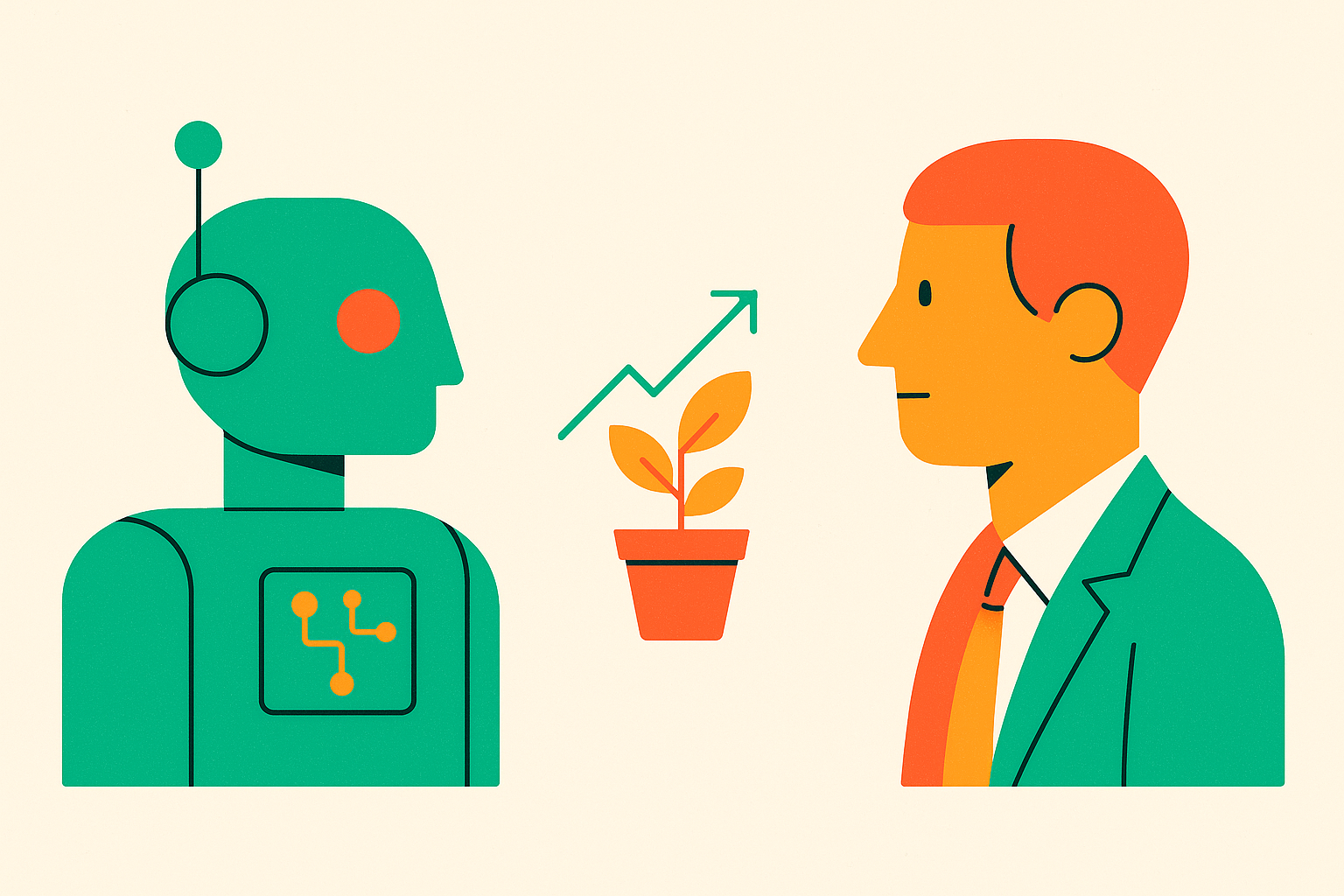
A small business owner staring at a growth ceiling has two levers: hire somebody or bring in AI. Most people frame this as a cost question, subscription versus salary, and that framing sends so many of them in the wrong direction. Growth stalls behind specific bottlenecks, and a hire fixes a different kind of bottleneck than AI does. I've watched owners run the math on a spreadsheet, pick the cheaper number, and still not solve the problem six months later. The question that matters runs deeper than the sticker price.
The U.S. Chamber of Commerce has tracked a sharp rise in small business AI adoption over the past few years. The live question is how owners actually choose between these two options, and that deserves better than a monthly bill stacked next to a salary line.
What a new hire actually costs before they add a dollar of value
The number on the offer letter is only the floor.
Payroll taxes stack on top of salary. So do benefits, equipment, recruiting fees, and the hours a senior person burns just getting the new hire up to speed. SHRM puts cost-per-hire in the thousands even for roles that need no special skill, and specialized positions (operations, finance, anything technical) push well past that, before the person has produced a single dollar of output.
Then there's the ramp. New hires take months to reach full productivity, and someone senior is training them the whole time, a cost buried entirely off the books. Harvard Business School's research on hiring economics puts the break-even point on a mid-level hire around month six. Six months of net cost, assuming nothing goes wrong.
Something usually goes wrong. Workers under 35 stay in a job for an average of a few years, so the clock on recovering that investment starts the day they walk in. A bad hire is a loss on top of that. The Department of Labor pegs the cost of a mis-hire at a meaningful chunk of that person's first-year salary once you count the lost productivity, the damaged client relationship, and the morale hit that spreads to everyone around them. The comparison owners keep running, AI's price tag against a salary number, misses the mark. The right comparison is AI's price tag against the fully-loaded cost of a productive employee.
What AI actually costs — and where the real variance lives
Monthly tooling costs for small businesses span a wide range depending on complexity and team size. Anyone who quotes you a single number without asking about your workflow first is guessing, and you should treat it that way.
The bigger variable is whether the thing was built right. A cheap tool bolted onto the wrong workflow produces almost nothing. A system built around the actual bottleneck compounds, and the difference between those two outcomes comes entirely from how well the system fits the actual workflow. Setup cost sneaks up on people too. DIY configuration feels free because it costs time rather than cash, right up until you price out what your own hours are worth. Managed implementation costs more on day one and usually reaches production faster, which tends to win on total cost even though it looks worse on the sticker.
Here's the part that moved fastest and that most owners haven't priced in yet: the API costs underneath these systems have dropped sharply since 2023. What was out of reach two or three years ago is affordable now. Total cost of a working system versus total cost of a productive employee is the comparison that holds, and on that framing the gap is wider than most people assume.
AI has its own failure mode, too: a system pointed at the wrong bottleneck, with nobody checking on it, runs silently and uselessly while the invoice keeps showing up. Put that in the ledger as well.
What each option actually unlocks — and what it can't do
A new hire adds capacity inside the model you already run. More hands means faster throughput and someone to cover when a person calls in sick. It leaves the process itself unchanged and the business's service offering fixed. Five people doing more of the same thing is still the same ceiling. It's just further away.
AI, embedded properly, works on a different axis. It opens up work the team physically couldn't take on before, expanding capacity rather than only accelerating existing tasks. A two-person shop quotes faster than a competitor running five people. A generalist handles a service line that used to need a specialist on payroll. Decisions that used to wait on someone the business couldn't afford to hire now get made on time, by whoever's already there.
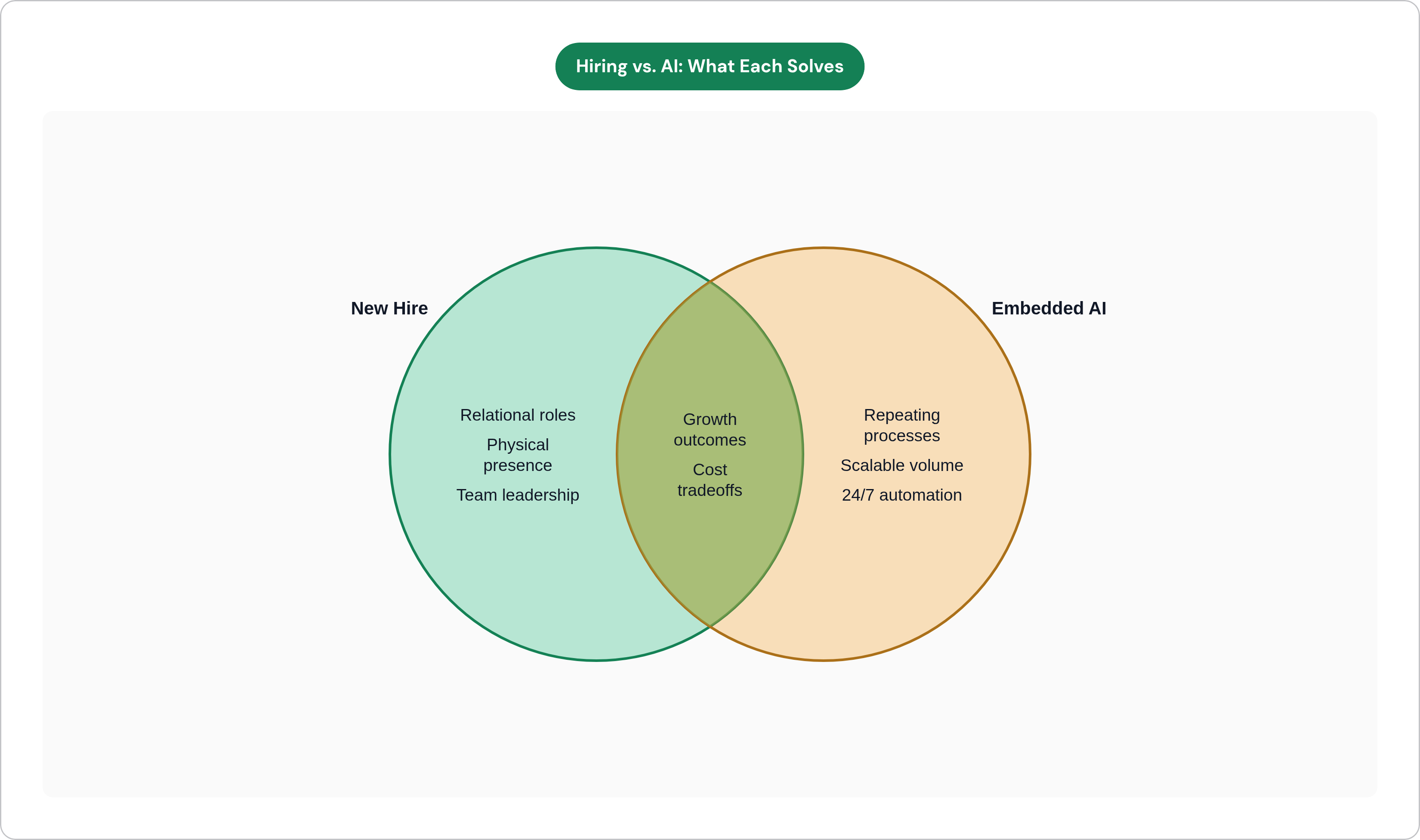
There's a real ceiling on this, and I'll say it flat: judgment built on human relationships, physical presence, or a genuinely novel problem nobody's seen before stays firmly in human hands. AI changes which jobs need people.
One thing that surprised me the first time I saw the data: Intuit's QuickBooks AI Impact Report found small businesses using AI are more likely to say it helped them hire than to say it led to cuts. AI and hiring serve different purposes: AI often comes first and makes the next hire sharper. Hiring raises the ceiling one person at a time. Embedding AI in the right bottleneck eliminates that specific constraint entirely.
The bottleneck test — how to know which option the business actually needs
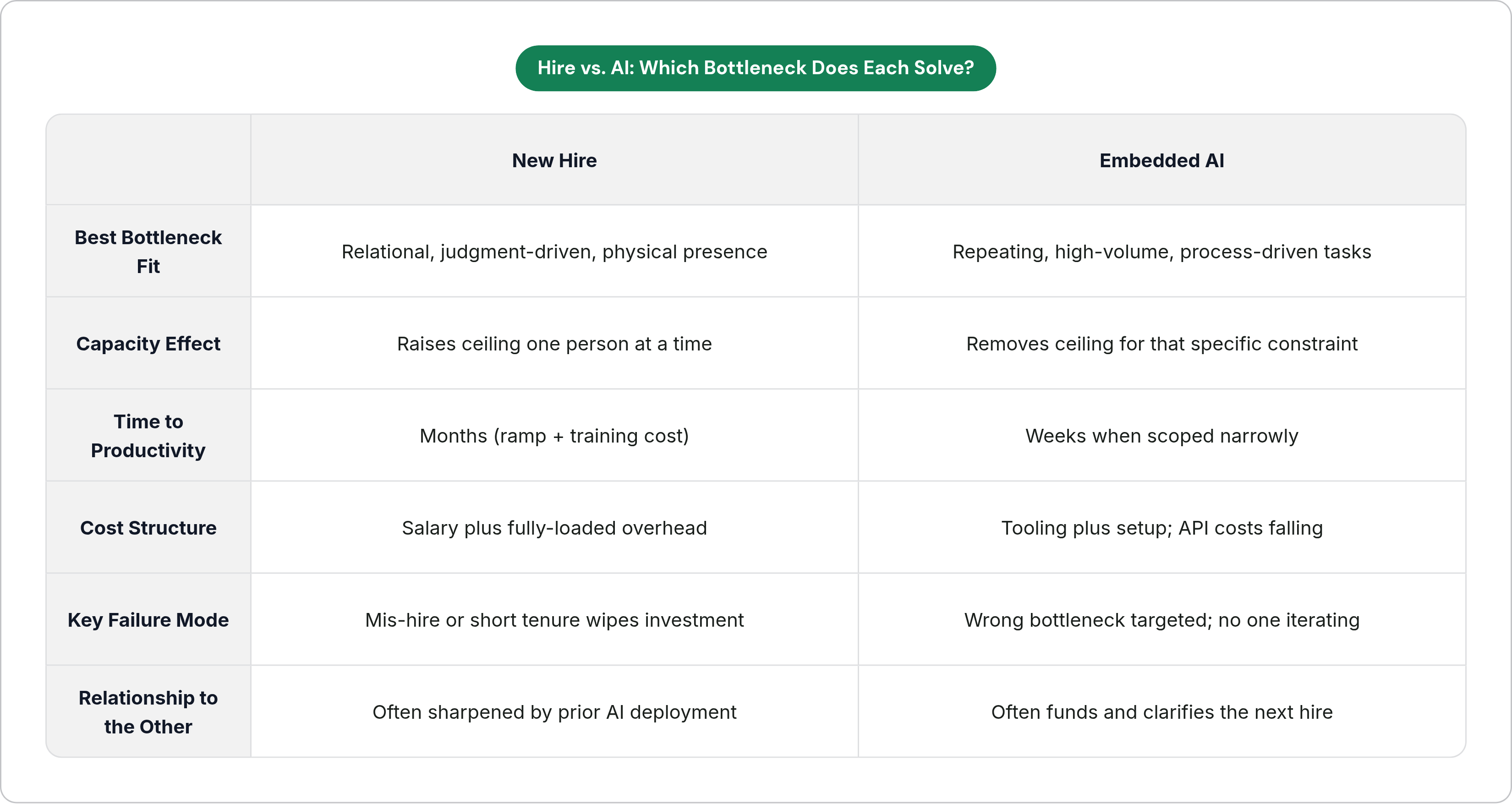
Start with the constraint, not whatever solution is trending in your feed. What's the one thing that, if it disappeared tomorrow, lets this business grow or take on more work?
If the bottleneck is relational, business development that runs on trust built over years, client relationships, team leadership, hire a person. Judgment in that room requires a person. If the bottleneck is a repeating process, data entry, quoting, scheduling, follow-up, document handling, AI clears it faster and cheaper.
Try this question on for size: would doubling the volume of this task require doubling the headcount? If yes, that task is a strong AI candidate. If your honest answer is "it's more complicated than that," the real bottleneck is still buried. Keep digging.
Then run the compounding test. Once the bottleneck's gone, what becomes possible that wasn't possible before? More of the same means a hire probably covers it. A new service line, or a client the business couldn't previously serve, means AI carries more upside. I've sat with owners who assumed for years that their bottleneck was headcount, when it was actually a process quietly eating hours across the whole team. Adding a person to a broken process just adds a second salary to the pile of hours already being wasted.
What embedded AI deployment actually looks like at a small business
There's a gap between using AI tools and embedding AI in a workflow. Most owners live on the wrong side of it without knowing it. Using tools means someone opens a dashboard when they remember to. Embedding means the system runs the process whether anyone's watching or not.
A first system worth building targets one high-friction, high-repetition process, rather than a general productivity layer that touches everything and moves nothing. The people who actually do the work should shape how it gets designed; adoption follows because you're solving their problem, grounded in their own experience rather than a consultant's diagnosis from a conference room down the hall. And it needs a number attached inside the first month or two: response time, volume handled, hours recovered. Something concrete enough to argue with.
The pattern holds across industries even though the details change. An insurance broker I know of watched manual data entry drop sharply once intake and policy documents started routing through an AI-driven system instead of eating three people's afternoons. A freight company automated dispatch and document workflows and recovered well over a hundred hours a month, which used to be another full-time hire. An HVAC firm handed after-hours calls to an AI phone agent, missed calls dropped, and next-day bookings were up inside a month.
That 30-day window isn't a sales pitch. It's what happens when a first project is narrow and specific instead of trying to boil the ocean. What kills these deployments is boring and predictable: a misdiagnosed bottleneck, a design built without team input, and ownership that evaporates once it goes live.
Why "embedded" is the word that separates outcomes from installations
Most AI projects produce a tool that stops short of becoming a system. It performs well under close attention, then drifts the second attention moves elsewhere. That's the installation problem, and it's why so many small business AI pilots quietly die a few months in without anyone quite noticing the moment it happened.
The embedded model differs fundamentally from a typical consulting engagement or a standard SaaS subscription. Someone stays inside the operation after launch, owns the measurement, catches the next bottleneck before it turns into a crisis, and connects the first win to the second one. That continuity is the actual mechanism: one system builds the capacity that funds and builds the next.
The enterprise world already placed this bet at scale. Major technology firms have committed hundreds of millions of dollars to putting engineers directly inside client operations, which tells you something worth paying attention to: deployment and iteration after the demo is where the real work lives. But a full-time embedded AI engineer commands a salary beyond most small business budgets, and the strongest talent in that pool gravitates toward large, regulated accounts that can pay for it.
Fractional embedded engagement is the workaround: someone who owns the diagnosis, builds the system, and stays on for the iteration, at a fraction of a full-time salary. The comparison to hiring is direct. A fractional embedded engineer often costs less than a mid-level hire, reaches productive output in weeks instead of months, and keeps compounding instead of sitting static in a seat.
When hiring is still the right answer
AI is one answer among several, and the right choice depends on the bottleneck. Relational and leadership roles, business development built on personal trust, client-facing work that needs continuity and emotional intelligence, team management: these still need a human in the chair. AI struggles here, and forcing it into these roles wastes money and damages relationships that take years to rebuild.
Physical presence matters too. Field work, hands-on service delivery, any role where the body actually being there is the product: that's a hiring decision, full stop. Sometimes the business just needs another senior thinker in the room, more judgment alongside more throughput, and that's a hire as well.
The sequencing matters more than the binary choice does. Often the smartest move is AI first, then hire. AI clears the process bottleneck, and the capacity that frees up shows you exactly what kind of person the business needs next. The hire that follows is sharper and higher-leverage, because the grunt-work ceiling already lifted before they walked in. Intuit's data backs this up: AI-adopting small businesses report more growth and are more likely to hire because of it. The tools change what the team is ready to take on next.
How to make the decision for your business
Start with the bottleneck, not the budget. What's the one constraint that, if it disappeared, changes what this business can actually do?
If that constraint is a repeating process eating hours across the team, run a focused AI pilot on it before hiring someone to do the same thing manually, just slower and with benefits. If the constraint is a capability the business genuinely lacks, judgment, relationships, physical presence, hire for it, and separately ask whether AI can free up existing staff to support that new person once they're in the seat.
Judge the pilot on one clear metric inside the first month: whether it moved the number you actually care about. Then ask the compounding question: what's possible now that wasn't possible before? That answer tells you whether the next move is another AI system or a hire with a job description that doesn't exist yet on your org chart.
The owners who get this right treat the first deployment as proof of concept for a new way of running the business, a foundation to build on rather than a box to check. Everything else, the tool, the hire, the org chart, follows from getting that part right first.