Market Research and Competitive Analysis Before a Service Launch
Diagnose customer pain before launch, or watch your service stall.

Pre-launch research fails for a boring reason: most SMB service providers skip straight to launch enthusiasm without answering three questions in order. Who actually has the problem? How badly do they feel it? And where are the current options failing them badly enough that they'd switch? That sequence, in that order, is the whole discipline. The dashboards and the thirty-slide decks sit on top of it as decoration, and they reveal themselves as decoration the day the launch stalls.
I've watched this play out enough times that I no longer find it surprising, just tiresome. The competitive environment has compressed for service businesses, which makes skipping the sequence more expensive than it used to be. Buyers have more options than they did five years ago, copycats move faster, and switching costs have dropped because most services onboard in days now instead of months. Only about one in eight SMBs has a dedicated AI strategy, according to a 2026 MedhaCloud figure, and I read that as a stat about how much of the small business world is improvising instead of diagnosing. Service launches tend to follow the same script: founder gets a good instinct, skips the diagnosis, launches anyway. Sometimes it works, but usually the postmortem doesn't say the product was bad; it says the wrong people got asked, or nobody bothered checking whether three other vendors had already half-solved the problem.
What "market research" actually means for a service business with limited time and budget
Forget surveys, focus groups, and paying a consultant for a binder that shows up six weeks later restating your own brief back to you in nicer font. For a service business watching its budget, market research means structured inquiry built to rule things out, tested against what you already hoped was true instead of simply confirming it.
This goes wrong two ways, constantly. First, you collect data that answers a question nobody asked: run a survey, get 200 responses, learn that people like efficiency and dislike spending more money. Groundbreaking. Second, and this one's more common, you stop at confirmation. "People have this problem" feels like an answer, but it isn't specific enough to act on. The real answer sounds more like: these people, feeling this problem this acutely, currently served this badly by these three competitors. Now go build something.
Good pre-launch research produces defensible answers that outlast the meeting where they got presented. What a small service firm can actually pull off in two to four weeks: desk research on segments and competitors, structured conversations with prospective buyers run as diagnostic interviews rather than pitches, and hands-on use of whatever competing product or service already exists. That's the list, and four moves done properly beat forty moves done sloppily, and it isn't close.
Worth separating primary research (talking to buyers directly, using competitor offerings yourself) from secondary research (industry reports, reviews, job postings). Secondary research tells you the shape of the market, while primary research tells you whether your read on that shape is actually correct. Lean on either alone and you end up confidently wrong, which is more dangerous than being uncertain, because the uncertain ones keep checking.
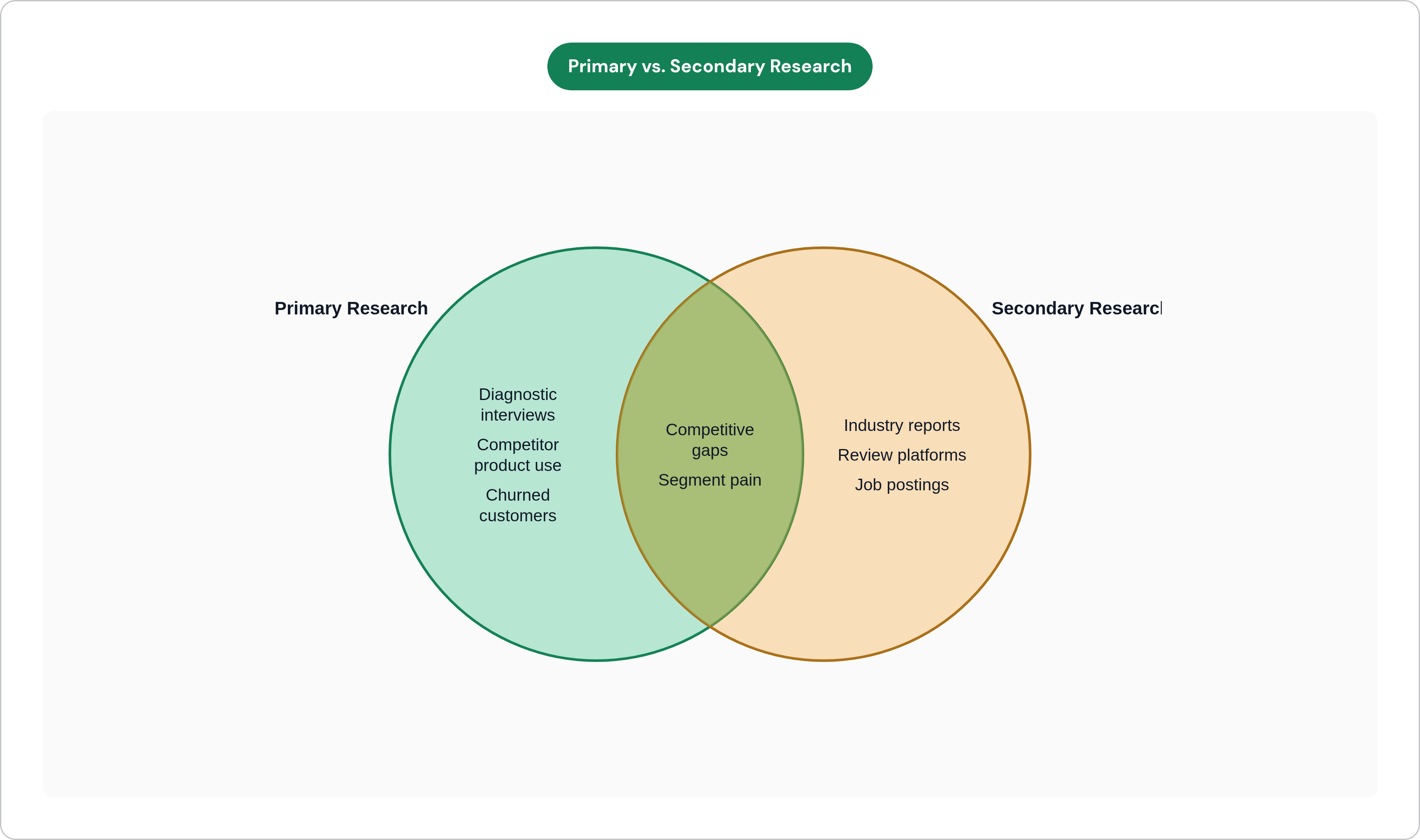
Identifying who actually has the problem — not who you assume does
Ask most service founders who their customer is and you'll get something like "small businesses" or "busy professionals" or "companies that need better X." Those are categories wide enough to include everyone, which means they don't describe the buyer precisely enough to act on.
A usable customer hypothesis names an industry, a company size range, the specific role of the buyer inside it, and the moment the problem actually shows up. "Small businesses need marketing help" describes nothing. Try this instead: regional HVAC companies with 15 to 40 employees, where the owner handles marketing on weekends, and the problem surfaces every time a competitor undercuts them on a bid they never saw coming.
Getting to that level of specificity starts with behavior: what people are already doing about the problem. Who's already trying to solve this, even badly? Who's buying adjacent services, complaining in forums, or hiring for a role that hints at a gap they haven't closed? Job postings are an underused tool here, since a company that keeps re-posting the same role is telling you it has a workflow problem that outlasts any new hire.
Segment by acuteness, not convenience. The group easiest to reach, through your network or a cheap ad campaign, is frequently not the group feeling the problem hardest. A logistics firm and an accounting firm might both nod along to "we need more efficiency," but the bottleneck, the buyer, and the urgency behind that word have nothing to do with each other. Chase the specific version of the problem and leave the broader category to someone else.
By the end of this step, write it down: a customer hypothesis specific enough that a stranger could read it and know exactly who to go talk to.
Testing how acutely the target segment feels the problem — and filtering out the politely interested
Acute pain leaves evidence. It doesn't just show up as enthusiasm in an interview room, which is exactly where a lot of founders get fooled by their own optimism, because enthusiasm is cheap and easy to produce on command.
There's a real gap between a felt problem and a funded one. Felt means the buyer nods and says "yeah, that's annoying." Funded means they're already spending time, money, or some clunky workaround on it, without anyone prompting them. Funded pain predicts a sale, while felt pain ends at a nice conversation.
In a diagnostic interview, listen for whether they can name the last specific time the problem cost them something real: a lost deal, a client complaint, a late night, a delayed shipment. Ask what they've tried already and why it didn't stick. Ask what changes for them, concretely, if the problem vanished tomorrow. Vague answers are the tell. "I'd definitely consider that" is the sound of a polite no, as is an answer delivered without a specific memory or a current workaround in place, however janky that workaround might be.
Roughly 74% of SMB leaders report improved organizational productivity through AI, according to the Upwork Research Institute. That number matters here for a reason beyond AI specifically: buyers in this world have already watched new approaches move the needle, so they expect proof rather than promises. They want proof someone like them already got fixed.
Pattern recognition is what you need at this stage, and somewhere between 8 and 15 interviews across your hypothesized segment is usually enough to see the signal repeat, assuming you're asking real questions.
What comes out of this step is a ranked list: which sub-segments hurt the most. That narrows down who the launch is actually for, sometimes more uncomfortably than you'd like.
Mapping the competitive landscape to find where existing solutions are genuinely falling short
Competitive analysis at the pre-launch stage means finding the failure modes your target segment has quietly learned to live with, the stuff they stopped complaining about because complaining never fixed anything, rather than assembling a feature comparison chart.
Three categories worth mapping: direct competitors doing roughly what you plan to do, indirect competitors buyers treat as a substitute even when it's a poor fit, and the status quo. The status quo is always a competitor, whether that means doing nothing, running a spreadsheet, or hiring someone internally to duct-tape the problem shut.
The best signal comes from unguarded complaint. One- and two-star reviews on G2, Capterra, Yelp, or Google describe what actually broke, cutting past what the sales page promised. Reddit threads, industry Facebook groups, and LinkedIn comment sections carry the same unfiltered frustration, usually with more color and fewer euphemisms. Five minutes with a churned customer can outweigh a week of desk research, since churned customers have nothing left to protect, so they just tell you.
Hunt for repetition: the same failure mode across multiple reviews or conversations, not one disgruntled outlier venting on a bad day. Pay attention to complaints a competitor's own marketing conveniently ignores; those are deliberate tradeoffs, which makes them exploitable. And watch for segments a competitor serves badly because their whole model got built for a different kind of buyer. Enterprise software crammed into an SMB's workflow is the textbook case, roughly the equivalent of wearing a three-piece suit to mow the lawn.
Only 12% of SMBs report having a dedicated AI strategy, versus 58% of enterprises, per the same 2026 MedhaCloud data. Wherever incumbent tools got designed with enterprise buyers in mind, the SMB segment ends up structurally underserved almost by default. This pattern shows up in any competitive landscape you're mapping, well beyond AI tooling, and founders consistently underestimate how common it is.
The output here stays short: two or three recurring failure modes shared across existing solutions. That list becomes your positioning, kept free of feature lists.
Sizing the opportunity honestly — what market data can and can't tell you before launch
Market sizing answers one question at this stage: is the segment big enough to build a business on, even capturing a small slice? Treat it as a growth forecast and you're one bad TAM slide away from talking yourself into a market that was never real.
Top-down data, the industry reports with the big number on the cover slide, sets a ceiling. Fine for a gut check, dangerous the moment you treat it as a prediction of your own outcome. Bottom-up sizing does the real work: count the businesses in your segment, multiply by estimated annual spend on solving this specific problem, and you get an addressable figure grounded in something you can actually defend in a room.
Use secondary data to check direction; it should inform decisions, not ratify ones already made emotionally. A growing segment with an unmet need beats a shrinking one even when today's numbers look identical, because tomorrow's won't. And a market where 74% of SMB leaders already report productivity gains from AI, per the Upwork figure above, is primed to respond to demonstrable proof rather than promises. That should shape how you position anything you eventually launch into it.
Market data leaves three questions unanswered: whether your positioning matches the segment's actual complaint, whether your price clears the bar of a funded problem, and whether buyers will trust a new entrant over the incumbent they distrust but still tolerate. Those answers live in primary research, regardless of how many pages a report runs.
If the only case you can make for a market is a big TAM slide and some general enthusiasm from a handful of conversations, the research isn't finished. Go finish it.
How AI tools can compress the research process without replacing its logic
The bottleneck in pre-launch research is time, not access to information: information is everywhere, free, and mostly unread. Specifically, the hours it takes to turn a pile of information into a specific answer to a specific question.
This is where AI tools genuinely earn their keep. Scanning and clustering hundreds of competitor reviews for recurring complaints used to eat days; now it happens in an afternoon. Drafting interview guides, then synthesizing raw notes into recurring themes, is another job that shrinks fast. Pulling secondary market data from a dozen scattered sources into something coherent is a third. AI is also decent at generating segment hypotheses worth testing, with the emphasis on testing, not accepting on faith because a model said so with confidence.
The judgment calls remain human work. Which signal actually matters, which segment gets prioritized when two look equally promising on paper, what a competitive gap implies for how you position against it: those decisions determine whether the launch works.
The risk with AI-assisted research is subtle. It's entirely possible to generate a long, polished, professional-looking document that answers a pile of questions nobody asked, replicating old-fashioned research theater, only faster and better formatted.
For most SMBs running this themselves, the real value of AI is compressing desk research from a couple of weeks down to a couple of days, which frees up time for the primary conversations no tool can run for you. The payoff compounds when the AI sits inside the actual research workflow the team already uses, embedded where they already work rather than siloed in a separate app. I keep coming back to a two-week diagnostic model some firms run on the same logic: find the single bottleneck with the most leverage, then build the rest of the process around clearing it.
Turning the research sequence into a go/no-go decision before committing to a launch
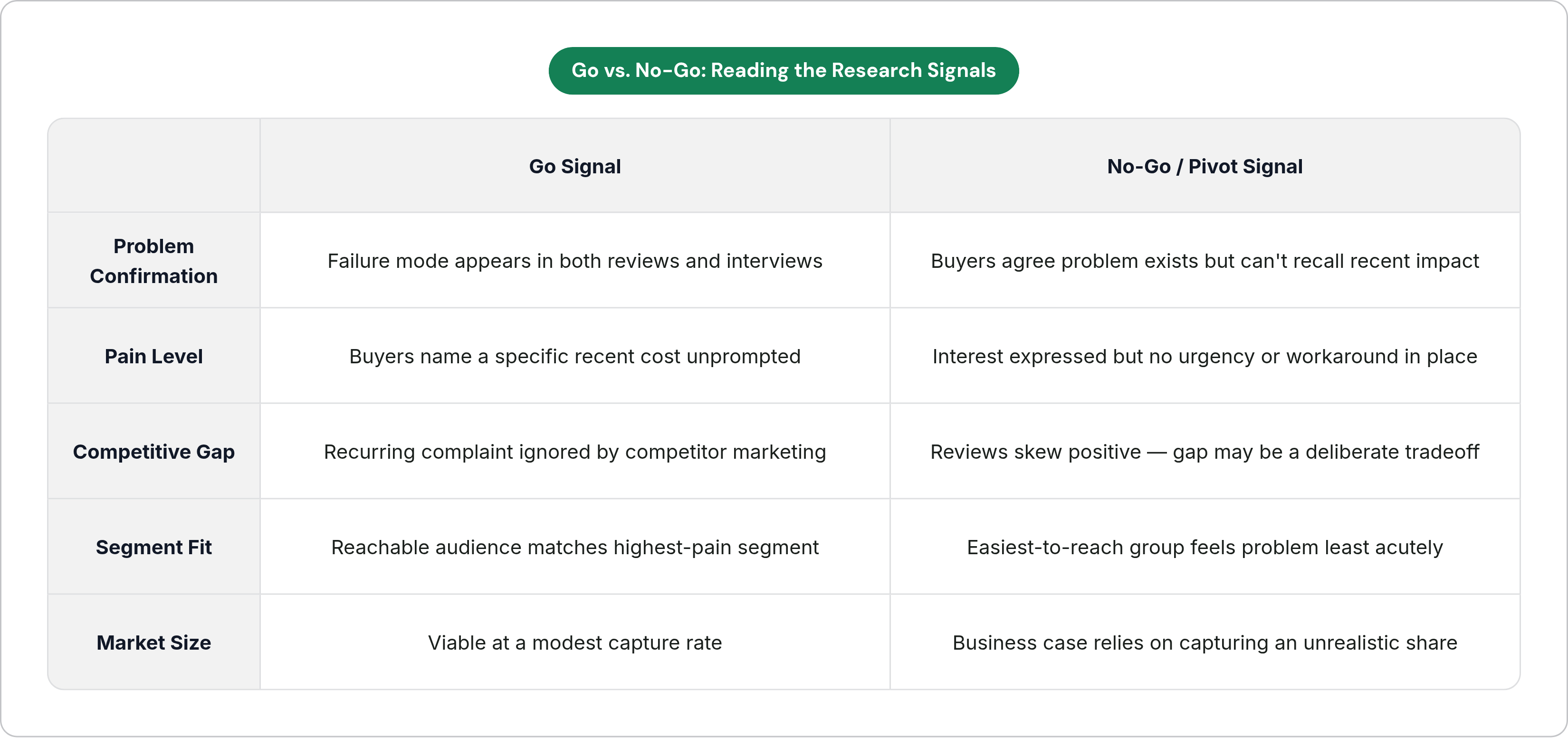
Research is done when you can answer all three original questions with evidence. Who has the problem: a named, described segment, industry, size, buyer role, context spelled out. How acutely they feel it: proof of funded pain, meaning what they've already tried, what it's cost them, whether they can describe the impact without you feeding them the words. Where existing solutions fall short: two or three recurring failure modes, confirmed independently in both reviews and buyer conversations.
Go signals look like this. The same failure mode shows up in competitor reviews and in your own interviews, so supply and demand confirm the gap independently of each other. Buyers bring up the problem unprompted and can point to a recent, specific instance of it costing them something real. The segment is large enough to build a business on even at a modest capture rate.
No-go or pivot signals look different. Buyers agree the problem exists but can't recall the last time it actually hurt them; that's interest without urgency, and interest without urgency doesn't pay invoices. Competitor reviews skew mostly positive, which means the gap you thought you found might just be a deliberate tradeoff rather than an exploitable flaw. Or the segment you can reach easily turns out to feel the problem far less acutely than the segment you should be building for. That mistake is common, and expensive in the way that actually matters: time and capital you don't get back.
A clean no-go confirms the process worked exactly as intended, and it costs an order of magnitude less than finding out the same thing six months into a launch that already burned the runway. Ask any founder who's lived through both versions which one they'd pick with the benefit of hindsight.
The final output should fit on one page: the segment definition, the evidence of funded pain, the competitive gap, and a go or no-go recommendation with the reasoning spelled out plainly. That page anchors everything that follows: positioning, messaging, the first ninety days of actually running the thing.