Goal Planning Strategies Solo Consultants vs Agency Owners
Solo consultants need different goal-setting logic than agency owners to survive and scale.
Solo consultants and agency owners get sold the same goal-setting playbook: set quarterly targets, protect your calendar, scale what works. It's bad advice for at least one of them, and the reason comes down to structure, not ambition. A solo consultant runs on 70 to 85% net margins, keeps every decision in-house, and gets paid for expertise and time. An agency owner runs on 40 to 60% gross margins, spread thin across billing rates and team costs, with payroll, benefits, software licenses, rent, utilities, and client acquisition all pulling from the same bucket every month. Applying solo logic to an agency, or agency logic to a solo practice, means the plan doesn't just underperform. It actively works against the business holding it.
Why the same goal-setting logic fails across both structures
Ask a solo consultant to plan their quarter: where's the personal leverage ceiling, and what's the one bottleneck that, if removed, makes everything downstream easier? If the same question is put to an agency owner, it falls apart, because their planning problem is a mix problem. It's a mix problem: what combination of throughput, margin, and headcount keeps fixed costs covered while still leaving room to grow?
Both groups get told to "get clarity first." True enough, but clarity means opposite things depending on which side of the payroll line someone sits on. For the solo consultant, clarity means figuring out what work to eliminate or hand off, since every hour spent on low-value tasks is an hour not spent on the thing only they can do. For the agency owner, clarity means figuring out what capacity to protect, since idle billable hours are the fastest way to turn a good month into a bad one.
The most expensive mistake happens when a solo consultant borrows agency logic wholesale and builds out a team before the revenue model can support the fixed overhead that comes with it. Run the math on a small agency: $15,000 in monthly fixed costs, billing at $150 an hour, needs 100 billable hours just to break even. Adding a 20% buffer for the inevitable slow week or scope-creep client brings the real number to 120 hours a month across the team. A solo consultant who hires before hitting anything close to that threshold takes their single biggest asset, high margin, and converts it into their single biggest liability, fixed cost that shows up whether or not the work does.
What AI changed for solo consultants: capability without headcount
For years, agencies held a structural advantage that no amount of solo hustle could close: faster production, broader skill coverage, and output quality that one person working alone simply couldn't match. That gap has closed. A solo consultant running a tool stack costing around $500 a month can now research, strategize, produce, and deliver client work at a level that used to require a five-person shop.
The economics behind that shift are almost comic in their lopsidedness. A solopreneur's tech stack in 2026 runs somewhere between $3,000 and $12,000 a year, a 95 to 98% reduction compared to what a traditional team setup costs to run. That's not an incremental efficiency gain. Renting an apartment costs far less than owning the building outright, except the building used to cost the same as fifteen apartments.
The scale of this shift appears in the labor numbers too. The solopreneur segment has grown substantially, and the category of output that used to require a full team to deliver credibly is now increasingly within reach of a single operator with the right tools. The agency's old moat, breadth of capability, isn't much of a moat anymore when one person with the right tools can cover the same ground.
What AI changed for agency owners: margin protection becomes the planning priority
Agencies are getting squeezed from a direction that has nothing to do with client volume and everything to do with what clients are willing to pay for. Clients won't keep paying for a junior consultant to spend six hours on research that a model can produce in minutes. Firms that built their pricing on hours-worked are watching that model erode in real time; firms that are actually thriving have repositioned around senior judgment, implementation, and outcomes instead of billable research time.
The upside, when it's captured correctly, is concrete rather than theoretical. One agency owner who automated data aggregation and PDF report generation reclaimed 16 billable hours a month, translating to roughly $4,800 in additional revenue capacity, and used that recovered capacity to scale from 30 to 45 clients without hiring a single additional reporting staffer. AI deployment inside an agency should get selected for its effect on throughput and margin. The 16-hour recapture example is boring in the best way. It's just math that works, not flashy. It's just math that works.
The Forward Deployed Engineer model's implications for both planning horizons
The Forward Deployed Engineer role, coined by Palantir in the early 2010s, describes someone who works embedded inside a client's actual operational environment, writes production code directly into the client's systems, and stays until the system runs. That's a different animal from advisory consulting, which hands over a slide deck of recommendations and calls it a deliverable. An FDE doesn't recommend. An FDE builds, and then sticks around long enough to make sure the thing built actually works.
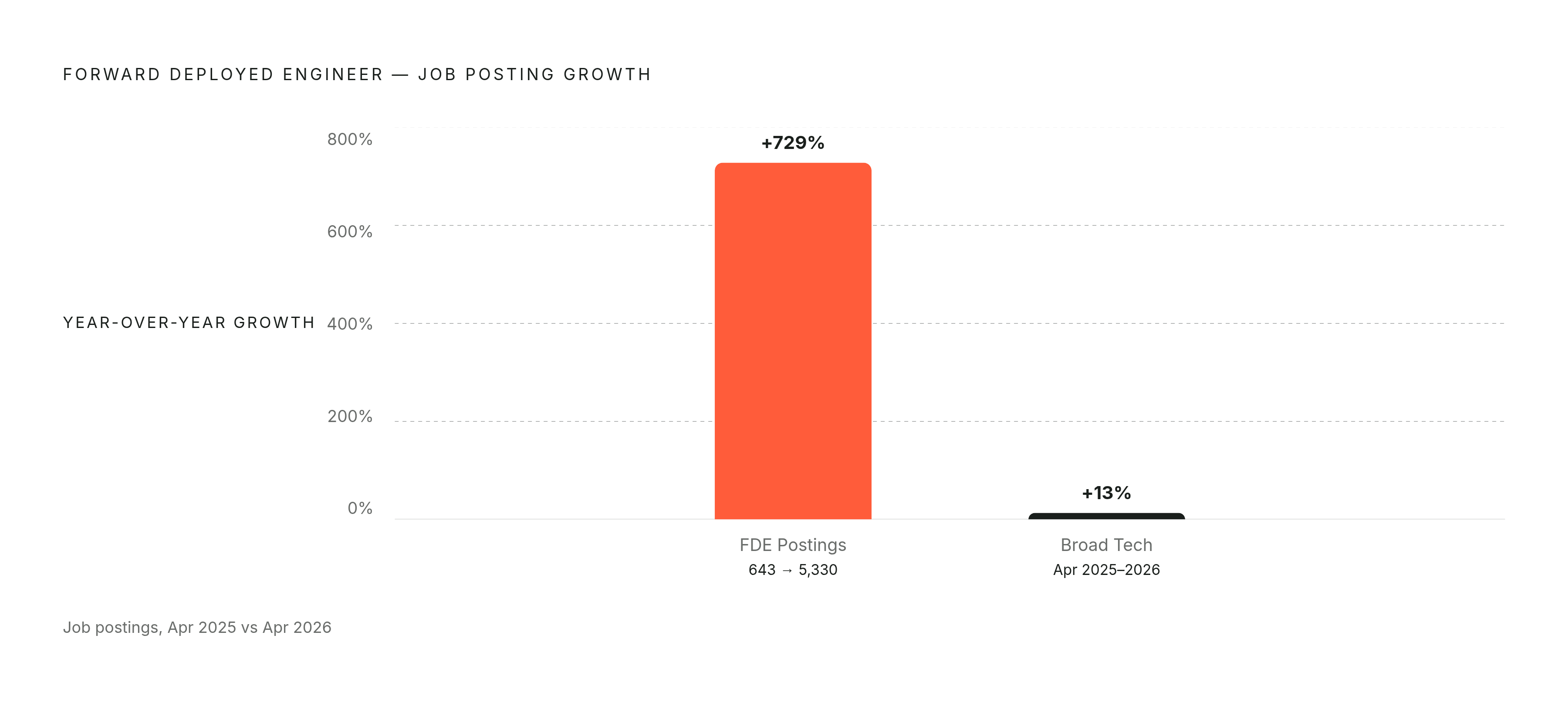
What used to be a niche hiring category at one company is now a mainstream job title showing up across the market. FDE job postings grew from 643 in April 2025 to 5,330 in April 2026, a 729% year-over-year jump. Lightcast data reported by Fortune shows forward deployed job postings up more than 1,000% between January and August 2026 compared to the same period a year earlier, and up more than 4,600% against 2023, against a mere 13% increase in broader tech postings over that same window. Employers are asking for people who'll embed, build, and stay. They're asking for people who'll embed, build, and stay.
That shift matters for both planning horizons because it redefines what "delivery" means. Solo consultants planning around this model start positioning themselves as the person who builds the system and doesn't leave until it's live. Agency owners planning around it start restructuring teams so that embedded, hands-on delivery becomes the default service instead of a premium add-on.
The AI ROI numbers that should anchor planning conversations, and the ones that should give pause
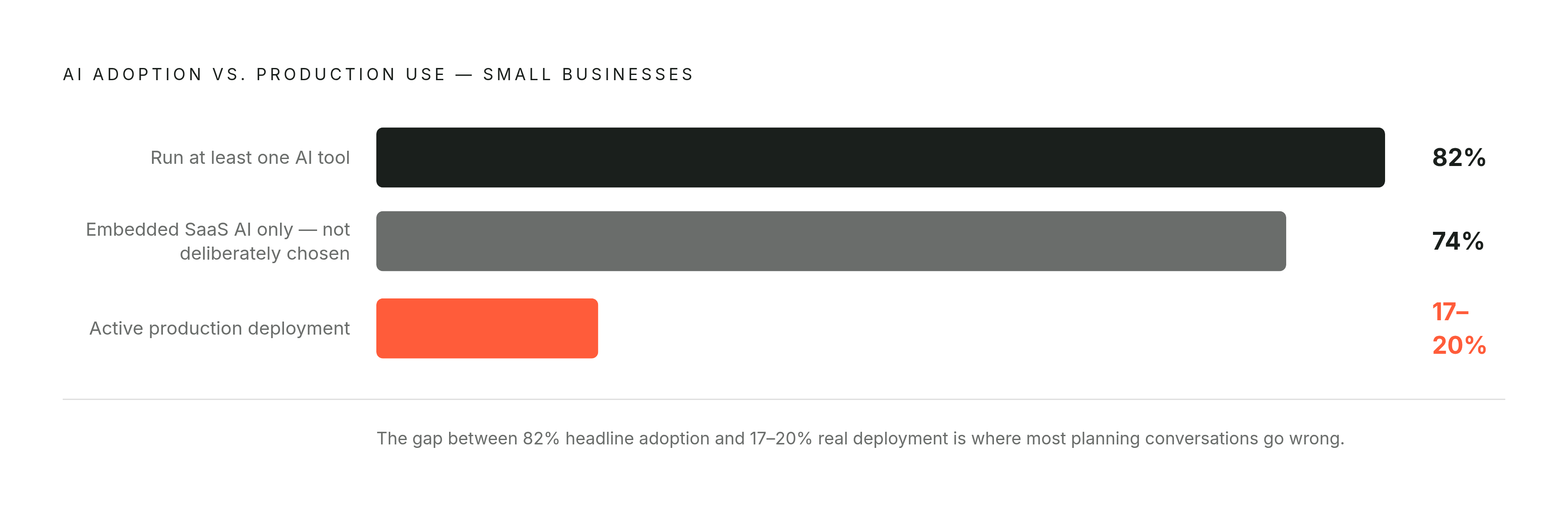
Start with adoption: 82% of small business employers run at least one AI tool in 2026, and 93% plan to keep investing over the next year. That's near-universal buy-in on paper.
Adoption is not the same as production impact, though, and the gap between the two numbers is where most planning conversations go wrong. Only 17 to 20% of small businesses actively use AI in production operations. The other 74% use it indirectly, through AI features embedded inside SaaS tools they already pay for, which is a very different thing from deliberately deploying AI against a specific workflow.
74% of SMBs report AI has improved productivity, but for most of them that improvement hasn't crossed the 25% mark yet. Industry data shows SMBs hitting positive ROI within six weeks of implementation, with 27% productivity gains and 23% cost reductions when it's done right. Spending has jumped accordingly: US private firms now spend an average of $2,068 on AI, a 50% increase over 2025, with professional and business services projected to hit closer to $3,470.
Then there's the number that should make everyone slow down before writing a check. MIT research puts the failure rate of AI implementations at 95%. The root cause is consistently traced to the gap between a capable model and a customer's actual workflows, actual data, and actual constraints. A model can be extremely good at the demo and still fail completely once it meets a client's messy CRM export and a spreadsheet held together with duct tape and inherited formulas. That gap is exactly where the Forward Deployed Engineer model earns its keep, since closing the last mile is the entire job description.
Practical planning frameworks: what a 30-day horizon looks like for each model
The market has settled on structured service tiers with defined timelines, and both solo consultants and agency owners are now expected to show results inside 30 days, not 30 weeks. Three tiers dominate: an AI Readiness Assessment ($2,000 to $8,000, delivered in 2 to 4 weeks) that produces a prioritized use case list with estimated ROI; an AI Strategy and Roadmap covering tool selection, integration planning, and phased implementation; and a Pilot Implementation covering an end-to-end build of one or two use cases, workflow design, data integration, and team training.
A solo consultant working a 30-day sprint should spend the first stretch auditing current workflows, identifying the single highest-leverage bottleneck, and defining the first deliverable in specific terms: named workflow, systems involved, expected time savings, and a review process to check the work actually holds up. The proposal discipline that separates solo consultants who close deals from those who don't is a two-week strategy sprint that identifies the best workflow, estimates ROI, and defines risk controls, then moves straight into the pilot without a lengthy pause for deliberation. The planning unit here is the delta. It's the delta: the time a task used to take versus what it takes now is the number that matters, not how many hours got logged along the way.
Agency owners running the same 30-day sprint start by identifying whichever workflow is eating the most non-billable or low-margin hours across the team, usually reporting, data aggregation, intake, or document generation. From there, the job is measuring throughput impact directly: the 16-hour monthly recapture example, the one that took an agency from 30 to 45 clients without adding headcount, is the working model for what a targeted deployment should look like. Building that business case internally, before it ever gets pitched to a client, gives agency owners a proof point that speeds up client trust considerably. Nobody has to take the pitch on faith when there's a before-and-after sitting in the agency's own operating numbers.
Where the two planning paths converge: the embedded model as the durable direction for both
Solo or agency, the planning strategies that actually compound over time are the ones built around embedding AI inside real workflows, instead of the ones that bolt a tool onto an existing process and hope for the best. Layering a chatbot on top of a broken intake process doesn't fix the intake process. It just makes the breakage faster.
For solo consultants, the embedded model means becoming the person who builds the system and stays until it runs, an FDE-at-SMB-scale role that frontier AI labs have no profitable way to serve themselves, since their business is selling the model, not sitting inside a client's operations for six weeks. That's a wide-open lane, and it's one no amount of API access can substitute for.
For agency owners, embedded delivery means shifting pricing and planning away from hours-worked entirely, toward outcomes and systems that keep running long after the invoice clears. Two different starting points, one solo and thinly staffed by design, one carrying payroll and overhead by necessity, but the destination looks the same from both directions: less selling of time, more building of things that work without anyone hovering over them.