Insurance Certificate of Insurance Request Workflow Automation
Automated COI workflows cut CSR time and E&O errors simultaneously.

Industry research has found that certificate of insurance requests eat more CSR time in commercial agencies than claims status calls or endorsement processing. That's the finding this article works from, and COIs generate zero revenue while consuming that time. A CSR who spends an hour producing one is an hour a CSR isn't rounding an account or fielding an actual coverage question. This piece breaks down what an automated COI workflow looks like end to end, where it saves time, and where it still needs a human with a pulse.
What makes manual COI processing error-prone, not just slow
Research on manual COI processing has found error rates between 8% and 15%. The usual suspects: wrong additional insured endorsement language, incorrect policy effective dates, mismatched certificate holder addresses. None of these are exotic mistakes. They're the kind of thing that happens when a CSR is retyping the same fifteen fields for the fortieth time that week and the coffee's worn off.
The consequence isn't hypothetical. Industry research on commercial lines E&O claims has found that COI errors, missing endorsements, wrong limits, expired policies, represent a significant share of agency E&O claims. Average settlement costs on agency professional liability claims are high enough that even a modest error rate gets expensive fast. Multiplying a small percentage by enough certificates makes the math stop being reassuring.
There's also a shelf-life problem nobody talks about at the intake desk. A meaningful share of small vendor policies get cancelled mid-term, usually for non-payment, so a certificate that was accurate the day it went out can be fiction three weeks later. Manual tracking almost never catches that gap. Add in the fact that only a small fraction of carriers reliably notify certificate holders when a policy lapses, and that manual review routinely misses document alterations like backdated PDFs or inflated limits, and the picture stops looking like a paperwork nuisance and starts looking like an open door.
The point isn't that automation moves faster, though it does. It removes an entire category of error that comes from a human retyping the same data by hand and missing the one policy that changed since Tuesday. That's where the E&O exposure actually lives, not in the slowness.
The four-stage architecture of a fully automated COI workflow
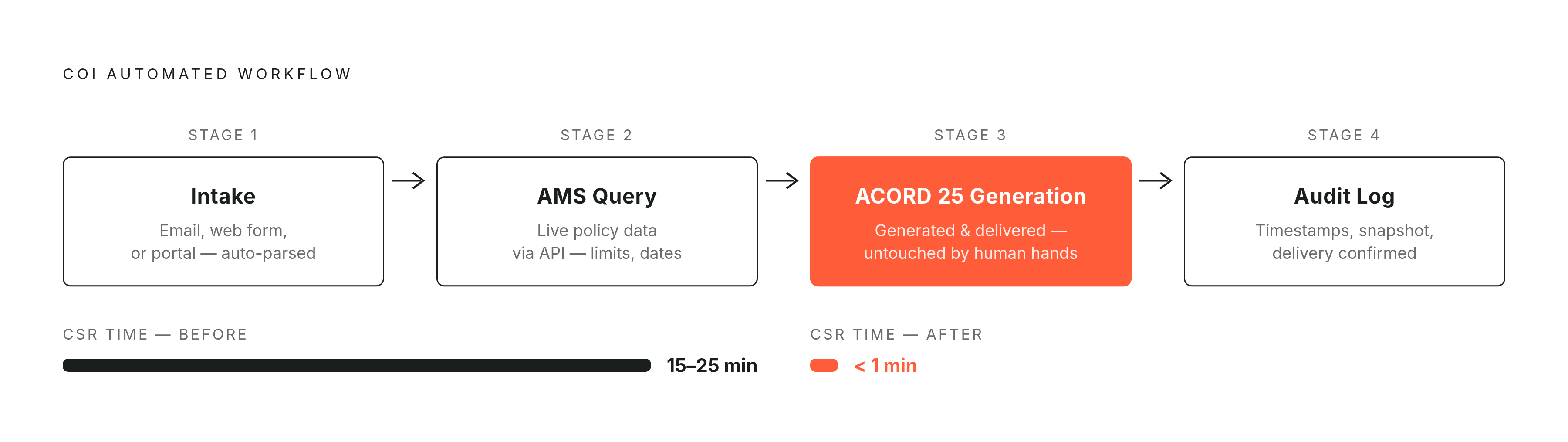
No agency management system handles COI issuance end to end out of the box. A working automated workflow needs four separate pieces stitched together: a trigger layer, AMS integration, ACORD document generation, and an audit trail that actually logs what happened.
Stage one is intake. A request lands by email, web form, or self-service portal, and the system parses out certificate holder details and the policy reference without a CSR opening the message. Stage two is the AMS query: automation pulls live policy data, current limits, effective dates, named insured, endorsements, straight from the agency management system through API access, instead of someone re-keying it from a screen. Stage three generates the ACORD 25 from that verified data and sends it to the requesting party. Routine requests finish here, untouched by human hands. Stage four logs the whole transaction: timestamps, a snapshot of the policy data used, delivery confirmation. That log is the compliance record manual workflows almost never produce consistently, because nobody writes down what they did when what they did took ninety seconds.
Done right, this drops CSR time per certificate from somewhere between 15 and 25 minutes down to under a minute on routine requests. That's not a marginal improvement; it's a different job.
An email template or an AMS shortcut macro isn't the same animal as something that just looks like automation. The real difference sits in the AMS integration and the audit trail. That's also exactly where most do-it-yourself attempts quietly fall apart.
The intake layer's handling of request variety without CSR involvement
Automation breaks at intake more often than anywhere else, and it breaks for a boring reason: requests show up as unstructured emails, phone calls, and the occasional fax, each with certificate holder information formatted a different way. Rule-based systems hate inconsistency. They don't fail loudly, they just quietly kick everything to a human, which defeats the purpose.
The fix isn't a smarter tool, it's channel design done before any tool gets chosen. Web forms, self-service portals, and email parsing rules that force structured input before the workflow even fires. Industry observers have noted same-day COI delivery improving substantially once agencies put self-service portals in front of the request flow.
AI earns its keep here specifically in classification, telling a routine certificate holder swap apart from a request that quietly involves a new additional insured endorsement, which needs a completely different path and probably a human. That difference is visible in intake in practice.
The design of the intake form matters more than which vendor gets picked. A poorly built form routes every single request to the exception queue no matter how sophisticated the automation behind it is. A meaningful share of requests need a human regardless of how well intake is designed. The job of a good intake layer isn't eliminating that slice, it's making sure the routine majority never slows down waiting for it.
AMS integration: why Applied Epic and Vertafore AMS360 are the practical starting points
The agency management system is the heart of this whole thing. Without API-level access to policy data, automation either falls back to manual lookup or degrades into screen-scraping, which is about as durable as a sandcastle at high tide.
Applied Epic and Vertafore AMS360 are among the most commonly referenced systems for broad API integration, and both support pulling policy data at the API level that automation can then hand off to document generation and delivery. No published 2025 ACORD connectivity standard ranks one ahead of the other on depth, so this isn't a case for picking a favorite, it's a case for checking what's actually available under the hood. Other platforms, HawkSoft and EZLynx among them, show up in the broader automation ecosystem for intake and quoting work, but API access varies by platform and contract tier, so it's worth auditing before committing to an architecture built around one.
DIY builds using tools like Zapier or Make handle simple intake fine. They fall apart on multi-policy COIs, certificate holder validation, and audit trail requirements, and that's not a knock on those tools. It's a scope mismatch, like using a stapler to build a deck. The honest constraint here: AMS integration is where low-cost automation attempts frequently fall short, and a production system needs an integration layer that handles multi-policy accounts, pending endorsements, and write-back logging without falling over.
Before evaluating any vendor or considering a build, the first question is which AMS the agency runs and what the contract tier actually includes for API access. That answer sets the ceiling on everything else.
Where AI does real work in COI review
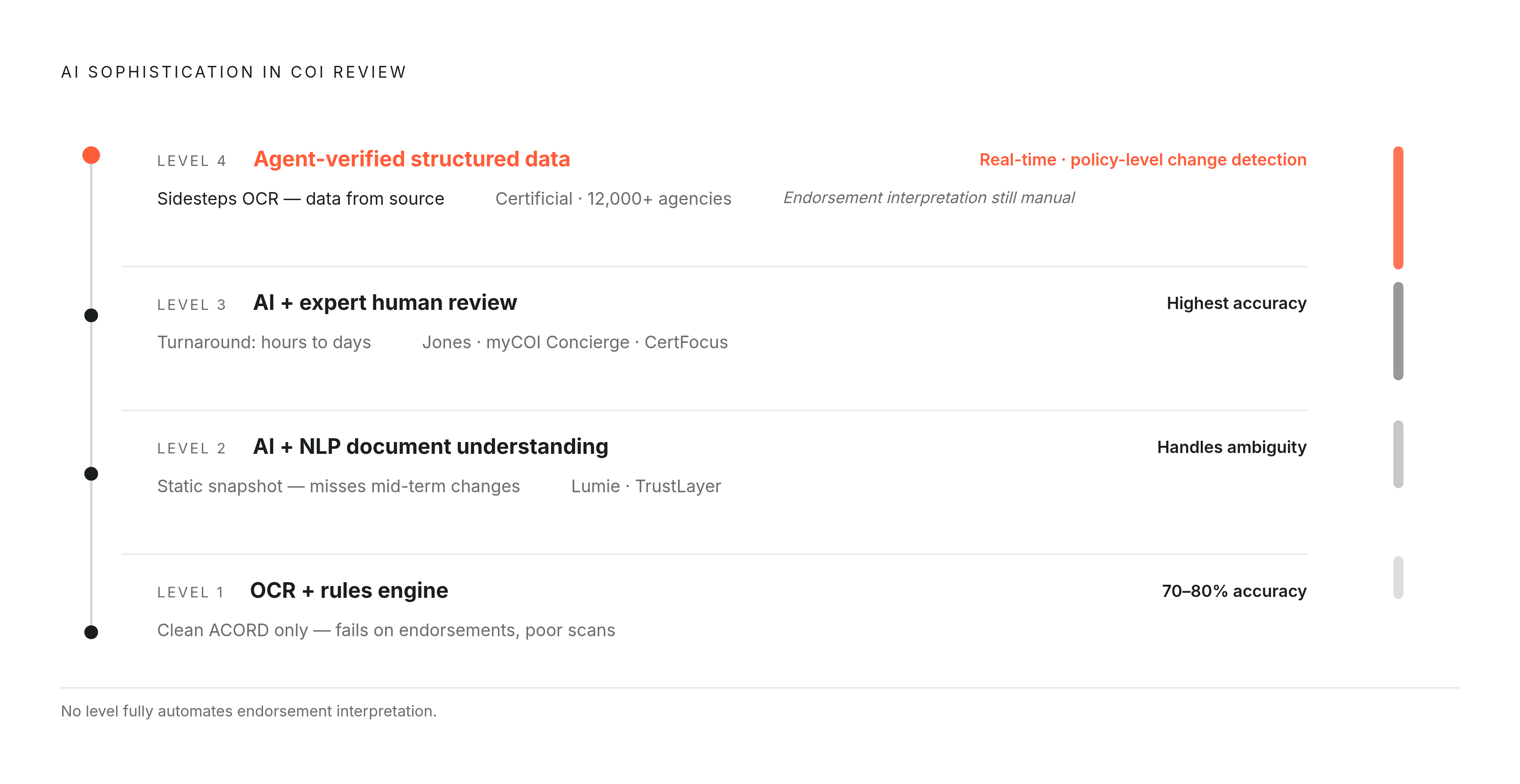
Every major COI tracking platform in 2026 uses AI somewhere in its review process, but "uses AI" spans four meaningfully different levels of sophistication, and vendors are not shy about blurring the distinction. Certificial's 2026 research lays the levels out.
Level one is OCR plus a rules engine: it reads characters, not meaning. Certificial puts accuracy on clean, standard-format ACORD certificates around 70 to 80%, and it falls apart on endorsement language or a poor scan. Level two is AI and natural language processing document understanding, meaningfully better with ambiguity and endorsement wording, but it's still reading a static document frozen at one moment. It has no way to know the policy changed last Thursday. Platforms that incorporate AI document understanding alongside rules-based review include illumend Lumie, previewed in October 2025, and TrustLayer.
Level three adds expert human review on top of the AI layer. Accuracy claims at this tier are at the high end of what vendors report, but turnaround stretches to hours or days because a person is actually reading the thing. Jones, myCOI Concierge, and CertFocus/Vertikal RMS operate here. Level four is agent-verified structured data, which sidesteps OCR and interpretation error entirely because the data comes from the source rather than getting extracted from a PDF. It requires the carrier or agent to actually participate in the network. Certificial's network spans more than 12,000 insurance agencies for real-time, policy-level change detection, which is the only approach among the four that catches a mid-term change instead of just reading a snapshot accurately.
No platform, at any level, fully automates endorsement interpretation. Every major vendor still routes complex endorsement language to a human. That's not a gap in the technology so much as an admission that endorsement language is genuinely hard to parse and getting it wrong is expensive.
The mid-term change gap deserves its own sentence because it's the more dangerous failure mode: accuracy gets measured at a single point in time, but policies change after that measurement, and most platforms have no mechanism to catch it. Research published in Health Affairs Journal, cited in Certificial's report, found that AI-driven insurance review that prioritized speed produced a sixteen-fold increase in claim denials, with 90% of those overturned on appeal. It's a blunt illustration of what happens when speed gets prioritized over judgment in insurance review generally, even though it's not a COI-specific statistic.
Vendor accuracy numbers like 99.9% or 99.5% aren't standardized across the industry, so they can't be compared apples to apples. The right question to ask a vendor is which platform handles the specific document types and change-detection needs a given book of business actually generates, not which platform is most accurate. It's which platform handles the specific document types and change-detection needs a given book of business actually generates.
The exception-handling path: what happens to the requests automation cannot complete
About a quarter of requests need a human, full stop, and a production-ready workflow routes those to a defined exception path instead of letting them sit in a queue gathering dust. Common triggers: a newly issued policy that hasn't fully loaded into the AMS yet, a request tied to a new additional insured endorsement that needs underwriter eyes, non-standard certificate holder language, or a multi-policy account with terms that don't line up cleanly.
Good exception design means the automation flags the trigger, opens a task in the CSR queue with all the extracted data already sitting there, and logs what kind of exception it was. The CSR shows up to apply judgment, not to go hunting for the policy number first.
This is where the time savings compound rather than just add up. Because routine requests never touch the CSR queue at all, the exceptions that do land there get faster attention, and the CSR is spending time on the ten hard cases instead of the ten hard cases plus ninety easy ones. One agency's six-month deployment data, tracked from July through December 2025, showed the residual error rate came entirely from one bounded category: requests tied to newly issued policies not yet fully loaded into Applied Epic. Not a scattershot of failure modes. One known, predictable gap.
Building the exception path has to happen before deployment, not as an afterthought once things start breaking. Knowing what the system will kick upstairs, and to whom, is what makes it safe to run without babysitting it.
What the time savings compound into at a real agency
The same agency's six-month tracking from July to December 2025 recovered 159 staff hours per week, roughly the equivalent of four full-time employees. That number alone doesn't say much. What happened with those hours does.
Two of the four CSRs previously dedicated to COI work moved to a new commercial lines growth team focused on cross-selling and account rounding. The other two shifted into complex claims advocacy. Nobody got let go. The agency didn't shrink its headcount, it found capacity for work it couldn't previously staff, which is the more interesting outcome than a cost-cutting story would be.
Annual labor savings from self-service COI portals run between $48,000 and $156,000 depending on agency size and volume, and that spread exists because it depends heavily on which AMS is in play and how much of the workflow is genuinely automated versus half-assisted. A mid-size commercial agency processing around 120 COI requests a month spends an estimated $3,600 to $6,000 a year in CSR labor just on this task. Automation brings that down to about 20 minutes of exception handling. ROI on a build like this typically appears within 60 to 90 days, sparing smaller agency owners the multi-year payback horizon that discourages them from investing.
Duke Fuqua's Federal Reserve CFO Survey data doesn't show CFOs expecting AI investment to produce measurable headcount reduction in 2026. The real payoff is capacity redeployment, taking on service lines an agency couldn't previously support, not trimming payroll. That's a meaningfully different pitch than the one AI vendors usually make, and it's the more honest one.
How long this takes to build and what it costs
Building this in 2026 costs less time and money than it did even a few years back. What used to be a twelve-month transformation project now runs an 8 to 12 week deployment for a single automated workflow chain.
Cost ranges widely depending on scope. A single ACORD-intake automation starts around $2,500. A full brokerage stack covering intake, quoting, renewals, and claims routing runs up to $30,000. Most 10 to 30 person brokerages pay somewhere in the $8,000 to $18,000 range for a full build, and most of them hit ROI within 60 to 90 days through recovered producer and CSR hours.
A sensible rollout follows a 30/60/90 structure. The first thirty days go to instrumenting and picking a bottleneck: turn on measurement before changing anything, so there's an actual baseline to compare against later. Days 31 through 60 are for narrow deployment, automation goes live on one workflow, with a human still approving anything that touches a customer directly. The final stretch, days 61 through 90, is for comparing the new numbers against the day-one baseline and making a call based on data instead of a gut feeling that things seem faster.
That structure isn't glamorous, and it won't make for a good case study slide. But whether the exception path was built first is what separates an automation project that survives contact with a real book of business from one that quietly reverts to email templates six months later.