Embedding AI Into the Daily Rhythms of a Sub-100-Staff Accounting Firm
Small firms automate their bottleneck workflows sequentially to free senior staff for advisory work.

Embedding AI into the daily rhythms of a sub-100-staff accounting firm starts with one bottleneck. The practical path is to automate the workflow consuming the most staff hours, measure the result, and use the recovered capacity to open the next. Document intake, reconciliation, tax preparation, and client advisory form a sequence of software rollouts.
Why the talent shortage makes AI a structural necessity for small accounting firms, not a productivity experiment
Small accounting firms are turning away clients while the clients they already have ask for more advisory work. The credentialed talent pipeline is shrinking, and CPA-required roles take longer to fill. Hiring is therefore an uncertain answer to a capacity problem that already exists. A firm cannot build its operating plan around the arrival of people it cannot find.
Ignition's U.S. Accounting and Tax Pricing Benchmark Report found most small firms structurally unable to deliver advisory because compliance production consumes their people's time. Sansatech, an AI transformation partner serving small and mid-sized accounting and services firms, identifies this squeeze as a core reason to embed AI into daily workflows. The constraint is not simply the number of CPAs available, but how much of their day goes to production rather than judgment. Automating that production layer changes the choice between hiring and refusing work. AI does not need to replace the accountant to remove the ceiling.
How can a small accounting firm implement AI without a firm-wide overhaul
Off-the-shelf AI tools offer a useful starting point because firms can test an established capability without commissioning a custom system. Document extraction, transaction matching, and workflow automation each address recognizable tasks. But buying those capabilities does not make them part of the working day. Training, workflow redesign, and human review can outweigh licensing costs, and AI adoption has more often increased costs than reduced them in the near term. A software subscription is not a completed implementation.
The right first move is a 30-day off-the-shelf pilot around one daily bottleneck. Pick the workflow consuming the most staff hours, run the tool on the firm's own data, and compare hours per item before and after. The usual order is to start with document intake, then move to reconciliation, tax preparation, and client advisory. Each stage supplies cleaner data or more capacity for the next, so starting everywhere at once skips the learning that makes later deployments easier.
This staged approach, also used by Sansatech, proves one workflow before committing the firm to a broader rollout. It exposes costs that a vendor demonstration cannot settle, including staff training and review time. A written AI policy belongs before deployment. Firms with a formal policy report clear ROI at a substantially higher rate than firms with no policy and no plans to create one. Firms need to check whether the hours they save go toward more clients or higher-value work, or get swallowed up by the work already waiting.
Document intake is the upstream bottleneck and the right first workflow to automate
Document intake includes receiving, classifying, extracting, and routing client documents. In the manual version, staff sort PDFs, chase missing items, enter data, and send documents to the right preparer. Much of this is high-volume, low-judgment work, yet it can consume senior hours at senior rates. Reconciliation and tax preparation cannot move cleanly while their inputs are still being assembled.
AI-powered document extraction and OCR can read PDFs and photographed receipts, extract the vendor, date, and amount, and suggest an expense category. These tools can also attach source images to transactions and flag incomplete submissions for follow-up. That changes the staff member's task from touching every item to dealing with what needs attention. When documents are clean and classified, the work that depends on them can start earlier in the cycle. Intake is therefore the kind of structural constraint Sansatech targets when diagnosing which workflow will deliver the fastest compounding relief.
The vendor shortlist depends on the job rather than on a general claim to be an accounting AI platform. Dext and Hubdoc are commonly cited document extraction tools, while Canopy's client collaboration platform and Karbon's workflow automation serve practice management needs. Those categories are related but not interchangeable. Extracting data from a receipt and routing work through a firm address different stages of intake. Compare how many hours each part consumes and how the tool fits the existing process.
Countsy shows what this looks like in practice. Vic.ai's Countsy case study describes an outsourced accounting services firm deploying its technology for accounts payable, a workflow that maps directly to a small CPA firm's AP intake. The vast majority of invoices are now processed autonomously, coding accuracy reached high levels, and processing time per invoice dropped dramatically. Colman Edwards, Countsy's Senior Director of Technology, described that decrease in processing time. The before-and-after shows a change in how invoices move through production.
Reconciliation and month-end close turn time savings into a multiplier
Once intake works, reconciliation becomes the natural next constraint. Staff otherwise match transactions line by line between bank feeds and internal records, build amortization schedules, and run flux analysis before each close. These tasks repeat across clients and reporting periods, so their workload grows with the client roster. Clean intake data makes automated matching viable. Without it, the reconciliation tool has to work through problems in the data it receives.
AI-powered reconciliation tools can match transactions, flag exceptions, and put together the supporting schedules. The accountant reviews anomalies. Hours per client per month then becomes a useful way to understand the effect on capacity. Across a meaningful client roster, recovered time can add up to hundreds of staff hours each month. That is where an intake improvement begins to support new clients without another hire.
Agentic AI is starting to resolve minor exceptions, ask vendors for missing information, and flag anomalies without a person prompting it. But this level of autonomy is still found mainly in top-decile AP deployments and is not widely available across the market. Touchless invoice processing is not evidence that every small firm can run an autonomous month-end close. The direction of travel supports pursuing the initial pilot, with autonomy as a longer-term goal.
Tax preparation automates production so senior staff can work at the top of their license
Tax preparation concentrates the same capacity problem into busy season. Data entry, filling in standard return fields, and preliminary checks take up CPA hours just when they are hardest to spare. AI can handle document summarization and extraction, populate return fields, flag issues for preliminary review, and route complex items to senior staff. The intended handoff is at the point where judgment becomes necessary. The firm's most expensive input device should not be its senior staff.
The distinction between a core product and an add-on matters here. Thomson Reuters UltraTax users who license the separate SurePrep 1040SCAN (Tax Automation) tools and the standalone Ready to Review CoCounsel app can prepare routine 1040 returns much faster than they can by hand. AI-assisted returns also take much less time to review, giving senior staff more time for complex tax planning and talking with clients. Those capabilities should not be treated as features automatically included with the base tax software. The pilot's costs need to include all the licenses the firm will need.
Faster preparation changes busy-season capacity without necessarily changing headcount. A firm can take on more clients or deliver the same volume with less overtime. Yet neither outcome follows automatically from reducing preparation time, particularly under a billing model that historically punishes efficiency. The Botkeeper example concerns bookkeeping automation, but the same conversion discipline applies to tax preparation. Recovered hours have to be redirected into more clients, higher-value advisory engagements, or new service lines if the firm wants efficiency to become revenue.
That distinction also changes what counts as success. A faster return is a production result, while additional client capacity is a business result. The pilot needs to establish the former before the firm can credibly plan for the latter. Otherwise, busy season can absorb every saved hour into other work without changing the firm's capacity ceiling. Automation has then improved a task without changing the business.
Client advisory is the capacity AI makes possible, not the place to start
Advisory is the payoff of the preceding workflows. Ignition's data shows that nearly all accounting firms said their clients wanted more advisory services in 2024. The missing ingredient was not demand but time to serve it. When intake, reconciliation, and tax production consume fewer hours, the same team has room for cash flow forecasting, KPI dashboards, and proactive guidance.
AI can support that work with forecasts from historical data, visibility into burn rate and working capital, anomaly and fraud detection flagging, and scenario modeling. These capabilities let staff apply their judgment to that analysis while automating the tasks behind it. The Free Minded Accounting Group (TFMA), founded by Jonathan Brown and serving athletes, entertainers, and entrepreneurs, deployed Digits' Autonomous General Ledger to compress its bookkeeping workflow. Annual cleanups went from taking weeks to taking days, freeing up time for more hands-on work with clients.
The tool supplies analytical capability, while the earlier workflow changes supply time to use it. Neither alone resolves the firm's constraint. The advisory conversation is also the natural place to make AI's role visible to clients through the guidance they receive. Clients gain better access to the firm's judgment.
How to sequence the four workflows and what a 30-day first deployment actually looks like
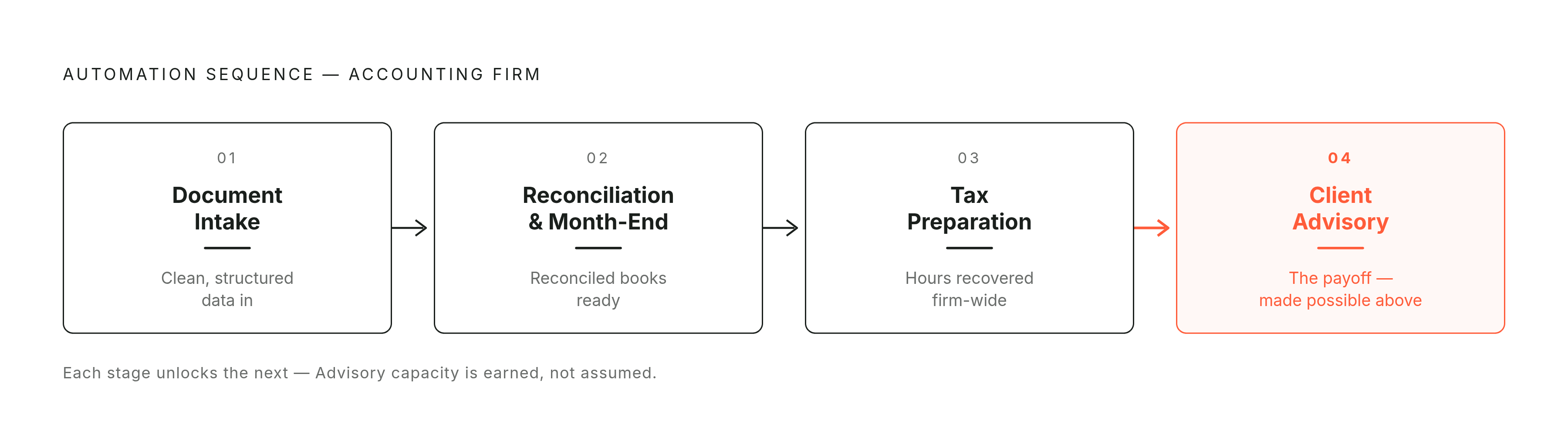
Document intake comes first because it supplies the inputs and has off-the-shelf options that can be deployed quickly. Reconciliation follows because classified data supports matching, while reconciled books support reliable tax preparation. Advisory comes last because it draws on both that data and the hours released along the way. The firm's actual bottleneck still determines its entry point, which for most sub-100-staff firms is intake or transaction categorization.
For a DIY deployment, the 30-day protocol is one workflow, one tool, and the firm's own data. Start with the workflow consuming the most staff hours per week, then run the vendor's demonstration on actual client data. Measure hours per item before and after for the same volume of work. Whole-firm hours saved are too diffuse to diagnose whether that workflow improved. The narrower measure makes a disappointing result as useful as a promising one.
Write the AI policy before the pilot goes live, and include the time and cost of training, workflow redesign, and human review when judging how it went. If the hours-per-item reduction is confirmed by the before-and-after comparison, expand to the next workflow and direct the recovered capacity toward its intended use. If it is not, switch tools or redesign the process before expanding. A failed pilot at this scale costs weeks. Its purpose is to make the next decision better.
For firms seeking a working system on a 30-day timetable without handling systems integration themselves, an embedded specialist is an alternative to the DIY route. SANSA's model has three stages, which are diagnosis, building, and embedding. It identifies the highest-leverage opportunities in two weeks, builds a production-ready system around the workflow, and stays involved through training and ongoing optimization. That addresses the specific gap between a capable tool and a system operating inside the firm's processes. The choice therefore assigns responsibility for integration and process redesign.
The first working system establishes a baseline, exposes the real costs, and shows whether saved time can become usable capacity. The next workflow then benefits from both cleaner inputs and a team that understands deployment. For an accounting firm under 100 staff, that is how AI becomes part of the daily rhythm. One production bottleneck gives way, and the next business opportunity becomes reachable.