Freight Proof of Delivery Collection Automation
Linking POD capture to invoicing cuts billing from days to hours.

Proof-of-delivery collection automation is about closing the gap between a completed shipment and a payable invoice. The bottleneck is a disconnected chain of collection, validation, billing and accounting, with a person bridging every gap. Automating that chain end to end changes how quickly a freight operation can close shipments and get paid.
Why the POD-to-invoice chain is a structural problem, not a process problem
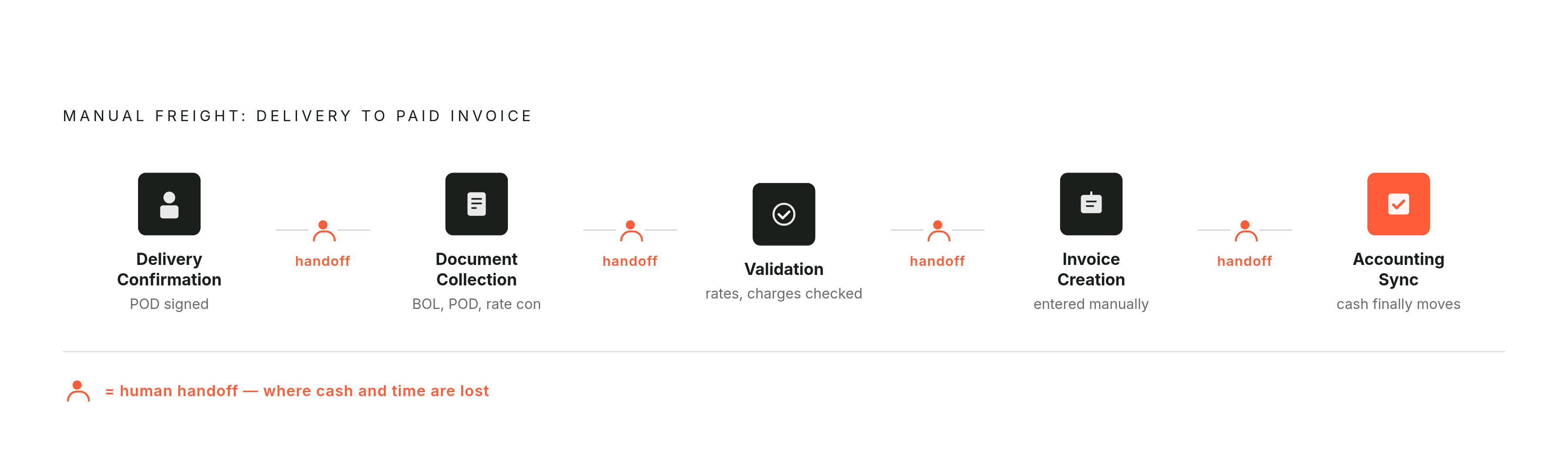
Freight moves in hours, but the cash comes in weeks later. The truck has finished its job. The document proving that fact still has several jobs to visit before finance can bill the customer. In a manual workflow, delivery confirmation, document collection, validation, invoice creation and accounting sync are separate handoffs. Each waits for someone to move the shipment’s information into the next system.
The disconnection starts before the proof of delivery, or POD, arrives. The quoting tool does not talk to the transportation management system, or TMS. The TMS does not automatically request the POD at delivery, and receiving the document does not trigger an invoice. Accounting then has to wait for someone to copy the billing data across. Checking the document faster on its own cannot end those waits in the next steps.
Format fragmentation adds another layer of friction. Warehouses, carriers and customers use different POD formats, so matching data, locating signatures and interpreting stamps require more than finding a file. Each shipment also generates other documents, including bills of lading, packing lists, certificates of origin, airway bills and customs declarations. Manual errors across that stack can cascade into customs holds, carrier disputes and client escalations. No single person’s diligence can connect the systems.
What manual POD handling actually costs a freight operation
The first cost is delayed access to cash. Enterprise shippers typically will not pay until they receive a proper POD and invoice, so an uncollected document blocks the billing cycle before payment terms even become relevant. Manual workflows add days, while the worst POD retrieval delays stretch into weeks. The resulting cash-flow gap limits what the business can take on next. A completed delivery is not yet usable revenue.
The second cost is revenue that fails to survive the paperwork. A missing or incomplete POD can trigger a dispute or rejected invoice, while invoicing mistakes and unchecked charges leave money uncollected. That creates more work as well as less income. Staff have to check the submissions against each other and chase fixes before they can close out the shipment cleanly. For smaller brokers and dispatchers already spending most of their day on repetitive administration, the follow-up also displaces revenue-generating work.
The third cost reaches the carrier relationship. Drivers waiting for paperwork, deciphering illegible forms or dealing with documentation disputes lose productive time. That friction gives carriers a reason to prefer competing facilities, affecting the relationships on which future capacity depends. The cost therefore extends beyond the back office. What begins as a missing document can strain cash, consume margin and make the operation less attractive to the people moving its freight.
What AI validation actually does to a POD document
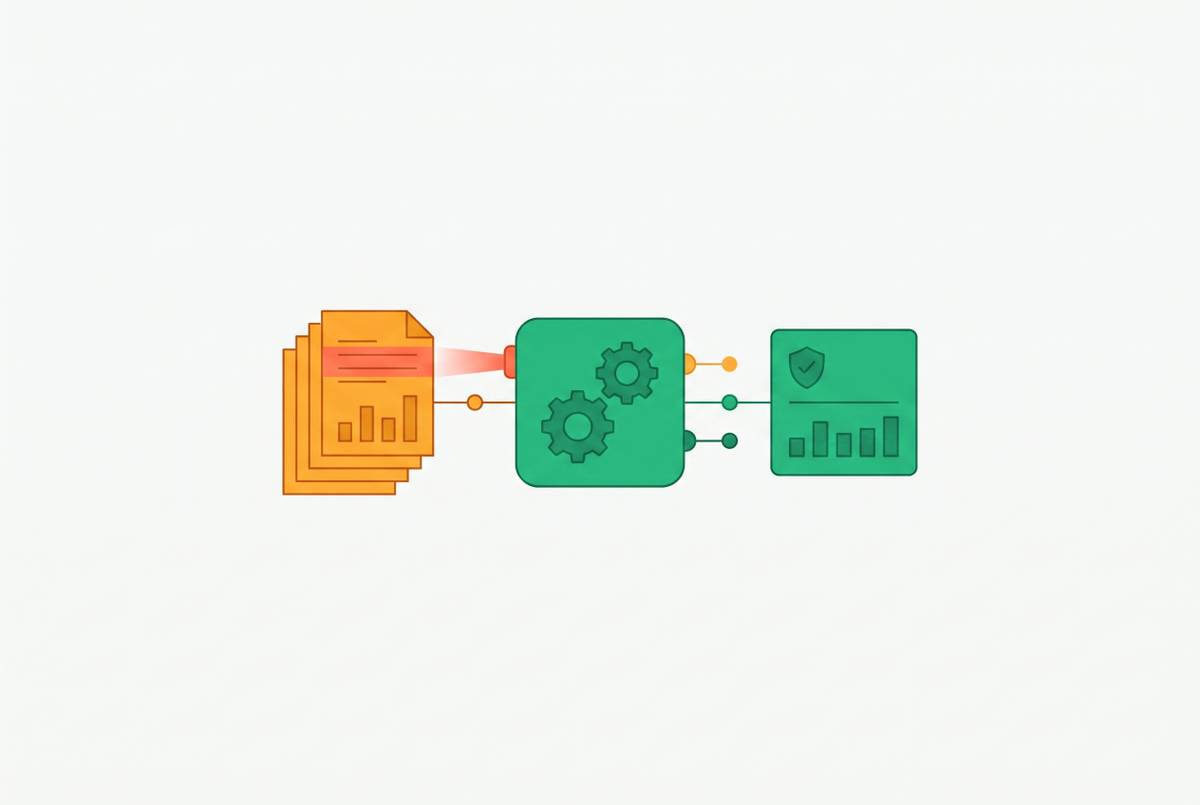
Fr8Tech’s Fleet Rocket TMS provides a concrete example of document-level automation. Its AI POD Validation module, launched in September 2026, receives a document, references the shipment record and returns Approved, Review or Rejected. The record shows a confidence score beside the POD, along with the evidence that backs it up. Computer vision and machine learning now handle the read-compare-approve loop that a person used to do.
The module uses multi-model signature and stamp detection with consensus filtering. Its structured OCR preserves label-to-value relationships, while spatial document understanding matches pickup numbers, bills of lading, carrier names and invoice data against the Fleet Rocket load. It also interprets English and Spanish stamps and checks document quality automatically. The decision comes with an explanation so operations staff can see why a document was approved, flagged or rejected.
That changes the allocation of human attention. The system handles the document volume, while staff focus on those flagged for review. The module is available to Fleet Rocket Enterprise customers and shows how validation works, though that does not make it the right product for everyone. Fr8Tech also expects to extend the same document-intelligence approach to carrier invoices and bills of lading. Those are planned extensions, not prerequisites for understanding the POD mechanism.
How automated validation connects to invoicing and closes the billing cycle
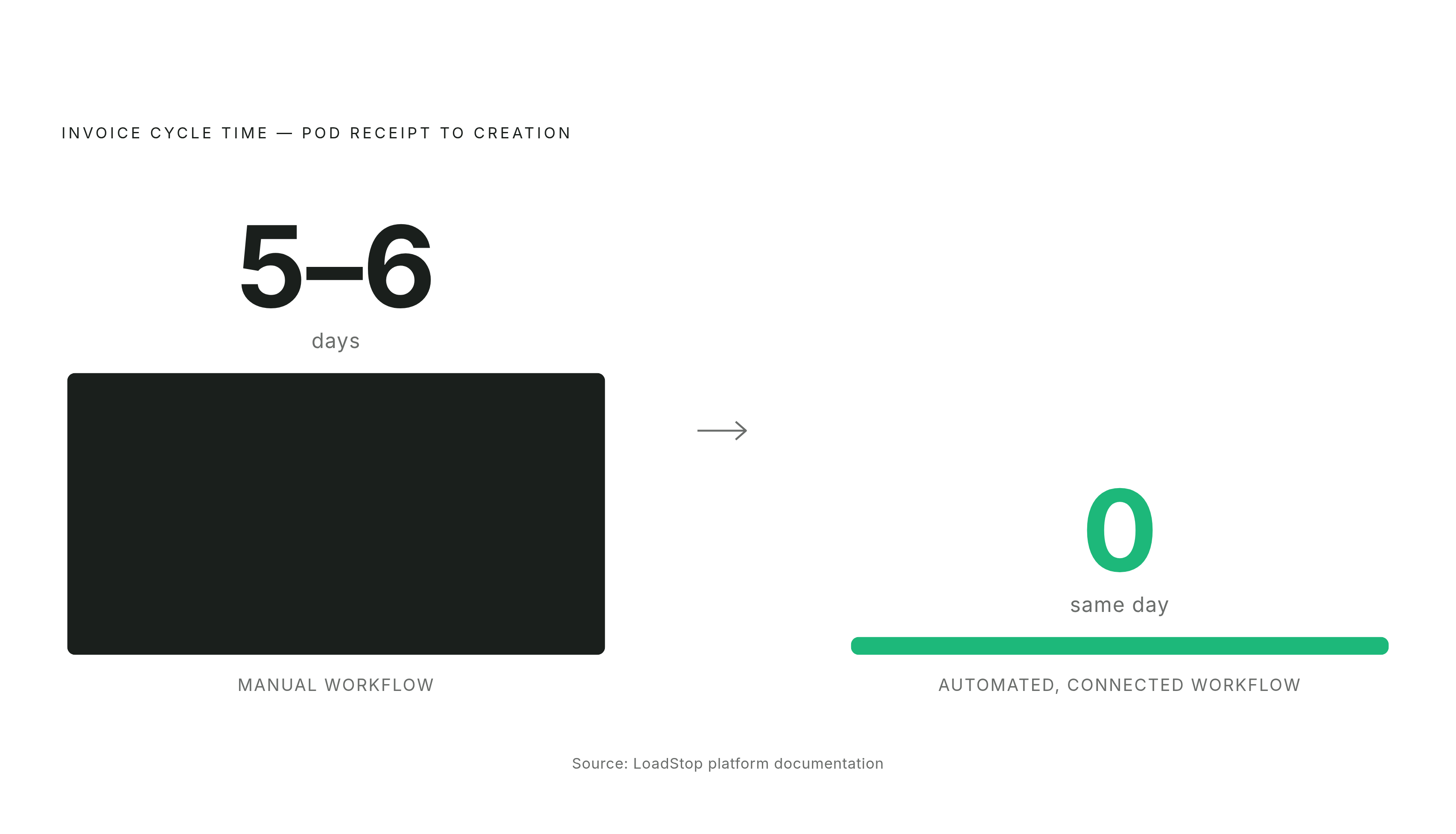
LoadStop’s platform documentation says invoice cycle time falls from five or six days to same-day when receiving a POD automatically triggers the creation of an invoice from verified load data. The causal link is the trigger. If a validated document still waits for someone to open the billing system, the review is faster but the wait for the next step is still there.
In the connected workflow, delivery confirmation leads to POD capture, followed by AI validation against the shipment record. The verified data then generates the invoice, which updates the accounting system without manual re-entry. Billing becomes the consequence of a completed validation. It no longer depends on someone remembering to begin a separate task after finishing the first one.
Automated checks also reduce invoice errors. Fewer errors mean fewer disputed invoices, rejected payments and follow-up calls, so the initial time saving is less likely to be lost in correction work. Collection enforcement supports that same chain by getting the required documents into it. Validation cannot release an invoice from evidence that never arrives.
What operations look like before and after automation — two concrete cases
Princeton TMX describes an unnamed mid-sized manufacturing shipper where only roughly a third of deliveries had a POD uploaded to the TMS. Finance staff spent hours reconciling carrier submissions, following up by phone and email, and entering data manually. Stricter POD enforcement, enabled by automated collection, lifted compliance above four-fifths of shipments. More deliveries arrived with the evidence needed to close them, reducing the dependence on staff pursuit.
SANSA reports a separate freight-company outcome in which automation recovered substantial staff time each month. Its proof point concerns time returned to the operation, rather than the upload-compliance measure in the shipper case. The available account gives less detail about the company’s starting workflow. It supports the result of replacing disconnected manual work with an automated chain, but not a claim about that company’s invoice timing or payment performance.
One shows a measurable improvement in document availability, while the other shows recovered working capacity. Neither requires the conclusion that staff suddenly became faster readers. Their shared pattern is the removal of work that depended on a person initiating the next step.
Why freight document automation pays back faster for SMB operations than for large ones
The objection that document automation is “for big carriers” gets the implementation burden backwards. Large enterprises have to work through legacy TMS and warehouse management systems, the extra work of change management and the time it takes to make purchases. Those layers can delay both deployment and returns. Smaller operations have fewer integration layers and shorter decision paths. Their size can make a focused workflow easier to put into production, even though their document volume is lower.
The labor cost is also more visible. At a small freight operation, one or two people may spend full days handling documents and chasing updates, with little spare capacity elsewhere to absorb the work. Automating tasks that take minutes for a system can release a substantial part of those people’s day. The return appears in the capacity of the existing team to do work beyond document handling.
That does not make every small carrier a good candidate. Below a certain monthly shipment volume, the cost-per-document case weakens, and the supplied evidence does not establish a universal numeric cutoff. Where document volume consumes working days, the structural case is strong. Where it does not, an automation deployment may offer less economic benefit than the same system would at a busier operation.
Why hiring more back-office staff does not fix the structural gap
Adding staff can distribute the paperwork, but it leaves the handoffs intact. Someone must still request the POD, inspect it, initiate the invoice and move the information into accounting. The operation pays more people to bridge the same gaps. Hiring may relieve an immediate workload without changing what starts the next step.
The added coordination has its own cost. More staff means more training, more opportunities for manual error and another training cycle when someone leaves. A five- or ten-person operation has little time for that extra work without taking people away from work that brings in revenue. Connecting collection, validation and billing addresses a different problem. It reduces dependence on manual handoffs while protecting against missed billables and slow cash conversion.
SANSA’s model is designed around that structural diagnosis. It identifies the bottleneck, builds a production system around it and stays embedded as the workflow develops. It reports that a freight company got back 160+ hours a month, a result specific to that deployment. It nevertheless provides freight-specific evidence for the alternative to staffing around the gap, which is giving the existing team a system that joins the work together.
The execution gap — why most freight operations that try automation don't complete it
BCG’s February 2026 Supply Chain Planning report describes high interest in AI and widespread experimentation, but only a fraction of organizations reporting meaningful returns. That broader finding shows why enthusiasm and working demonstrations are insufficient evidence of operational value, while leaving the POD-specific failure rate unestablished. The difficult step is getting a system to function inside the workflow.
For an SMB freight operation, that requires a specialized capability. Taking an AI agent from a working concept to reliable production, then keeping it working as model providers update, is not a skill the business necessarily has a reason to employ internally. A technology-first purchase can leave that responsibility unresolved. The team receives a tool without owning the implementation needed to make it useful. In that situation, stalled adoption does not prove that document automation itself failed.
Successful deployments begin by finding where the steps in the workflow fail to connect. The internal team participates in the implementation. That involvement connects technical work to the exceptions and handoffs the operation must handle. Execution risk remains, but it becomes something the deployment addresses explicitly. Finding the real bottleneck first is what makes a viable scope possible.
What a 30-day POD automation deployment actually looks like for a freight operation
A 30-day deployment is credible only with disciplined scope. Before anyone writes code, discovery must find the gaps in exception-handling, the bottlenecks in the workflow and what integration will require. The first target is limited to a production-ready POD-to-invoice workflow. That distinction keeps the timeline grounded.
SANSA starts with a two-week diagnostic to find the AI opportunity that would make the biggest difference. A build phase then produces a working system around that opportunity, with engineers inside the client’s tools, participating in sprints and sharing responsibility for integration with internal staff. The embedded relationship continues beyond the first workflow. It is intended to turn the initial gain into faster decisions and new service capacity, rather than leave the team with a product it must integrate alone.
For a freight team considering this approach, the practical expectation is a scoped workflow in production within weeks, conditional on what discovery finds. The 30-day window is not a promise that every integration problem fits the calendar. SANSA’s placement here rests on its diagnostic and embedded delivery model, supported by its freight result. Talent and ambition were not the missing links. Access to a system that joins the chain was.